Appliance service · Bay Area
Commercial Refrigerant Leak Repair · Bay Area
EPA-certified sealed-system work. Find the leak, fix it, recharge to spec.
- $99 diagnostic (credited toward the repair)
- Same or next-day best effort
- Insured · CSLB #1136642
What we do. What we fix.
What we do
A refrigerant leak is the most common reason a commercial box stops cooling, and the one repair most service techs can’t legally or properly do. ADRIUM is EPA-certified (EPA #1279674151528) to find the leak, repair the sealed system, and recharge your unit the right way.
Handling refrigerant requires EPA certification by law. Recovering the old charge, locating the leak, brazing the sealed system, evacuating, and recharging to spec also takes tools a general handyman doesn’t carry. That is why a leaking commercial unit often gets a shrug and a “you need a new one.” Sometimes that is true. Often it isn’t, and we can tell you which.
How we find and fix a leak
- Diagnostic. $99 service call, includes a full check of the system.
- Leak test. We scale the test to the unit:
- Basic. Pressurize with nitrogen, inspect the visible parts. From $150.
- Full. Coil check with an infrared/ultrasonic leak detector, nitrogen, and a bubble test on the connections. Up to $400.
- UV dye test. Added when a leak is elusive. Plus $200.
- Repair the sealed system. Braze the leak, replace failed components like the filter-drier.
- Evacuate and recharge. To the correct refrigerant type and volume. We diagnose the fault on site, then provide a written repair estimate before any work starts.
If a piercing valve has to be installed to access the system, that is added labor plus the part. We quote everything before we start.
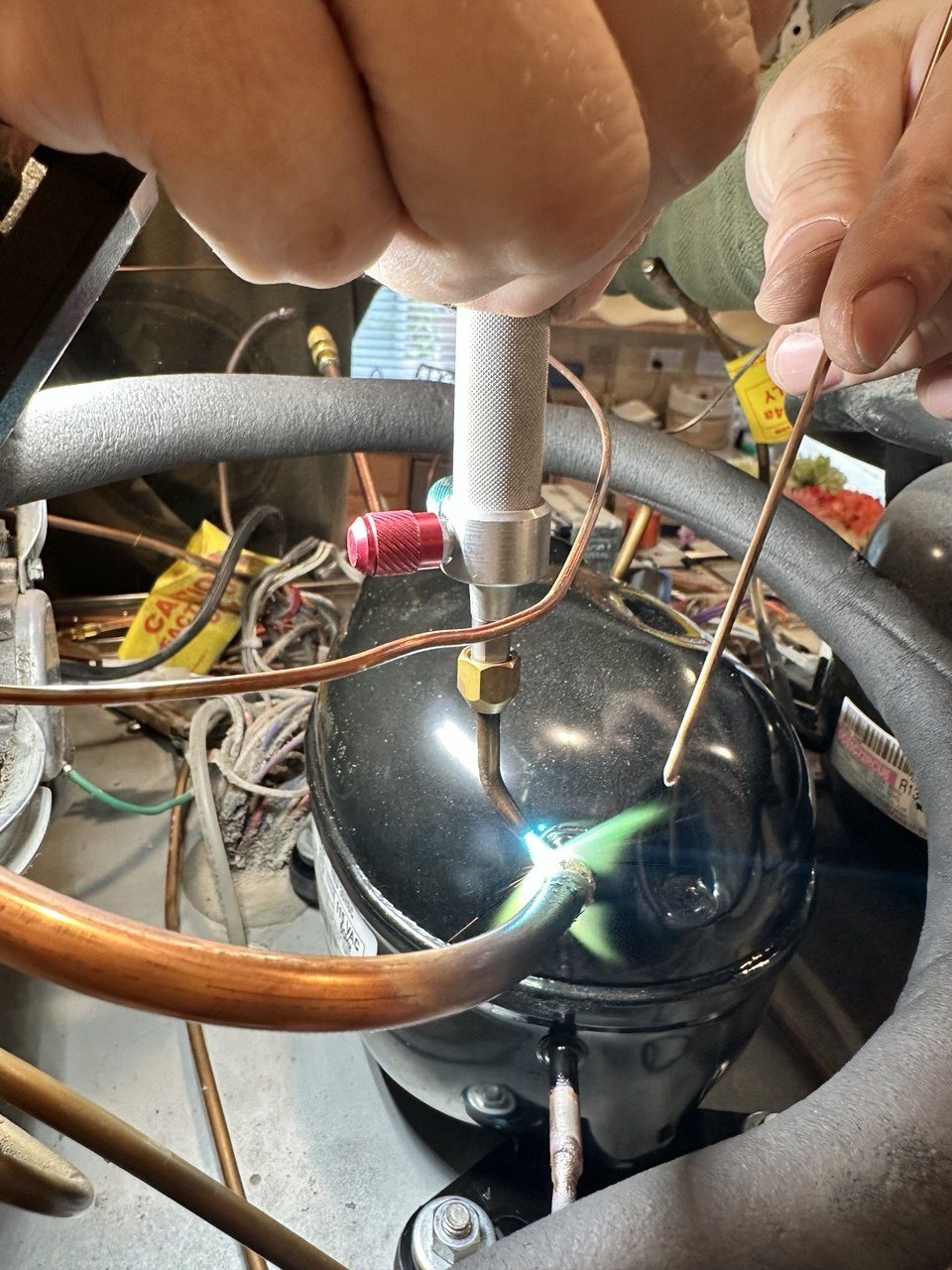
What a leak test actually looks like
How we tell a leak from a restriction or a low charge
A box that is not cooling is not always a leak, and the wrong call wastes the customer’s money. Before we open anything we read the system, because a leak, a low charge, and a blocked cap tube all look like “not cold” from the front but show up differently on the gauges.
First we let the system equalize. Shut the compressor off and watch the high and low sides come together. A healthy system settles in about ten to fifteen minutes. If it crawls or never equalizes, that points at a restriction, a cap tube or filter-drier choked with moisture or braze debris, not a leak.
Then we read against spec. On a working sealed system the condenser runs about 90 to 110 degrees, the low side sits around 0 to 10 psi, and the high side around 90 to 110 psi. From there the pattern tells the story. A low charge or a low-side leak reads low pressure on both sides with the evaporator only partly frosted at the inlet and the condenser cooler than it should be. An overcharge runs high on both sides with a frosted suction line and a hot condenser. A full restriction frosts almost nothing and pulls the low side into a vacuum. Compressor amp draw backs it up: normal is roughly 0.3 to 0.8 amps, a draw over 1.0 hints at moisture in the system, and a draw under 0.3 hints at a restriction starving the compressor.
That ten minutes with the gauges is the difference between brazing the actual leak and replacing a compressor that was never the problem.
Repair or replace
A sealed-system repair is the most expensive fix on a commercial box. On a commercial unit, a True reach-in, a Turbo Air prep table, a Perlick bar fridge, repairing the system is usually worth it against the cost of a new commercial unit. On a cheap residential fridge, it often isn’t, and we will say so rather than sell you a job that doesn’t pay off.
What causes leaks
Vibration, corrosion, and age open up the sealed system over time. Skipped maintenance, dirty condensers, and worn gaskets making the compressor overwork accelerate it. Our preventive maintenance catches problems early, and a WiFi temperature sensor alerts you the moment a unit drifts out of range, before you lose a walk-in of product.
Why ADRIUM
- EPA-certified refrigerant handling, done legally and to spec.
- Sealed-system work on True, Turbo Air, Atosa, Perlick, Beverage-Air, Continental, and Traulsen, and any Embraco or Tecumseh compressor system.
- Straight repair-or-replace advice. Fast response, because a warm box is a clock on your inventory.
This is part of our commercial refrigeration track. Unit not cooling and you suspect a leak? Call ADRIUM and we will get you back to temperature.
What Sealed-System Work Looks Like
Commercial Refrigerant Leak brands, by tier.
- Serviced
 True Reach-ins, prep tables, under-counters, bottle coolers. Brand details →
 - Serviced
 Turbo Air Reach-ins, prep tables, under-counters, merchandisers. Brand details →
 - Serviced
 Atosa Reach-ins, prep tables, undercounter commercial fridges. Brand details →
 - Serviced
 Perlick Back-bar refrigeration and beer-line service. Brand details →
 - Serviced
 Beverage-Air Reach-ins, back-bar coolers, under-counters, prep tables. Brand details →
 - Serviced
 Continental Reach-ins, prep tables, under-counters. Brand details →
 - Serviced
 Traulsen Reach-ins, roll-ins, under-counters, blast chillers. Brand details →
Cities we cover across the Bay Area.
Don't see your city? We cover most of the Bay Area: Tri-Valley, Diablo Valley, Inner East Bay, Peninsula, and South Bay. Ask when you call.
Pricing & warranty
No mystery numbers.
-
Diagnostic
$99
credited toward the repair.
-
Repair warranty
3 mo to 1 yr
Parts + labor on completed repairs. Term varies by part.
-
Repair cost
Quoted
Final cost depends on parts and the time the job takes. Written quote before we start.