
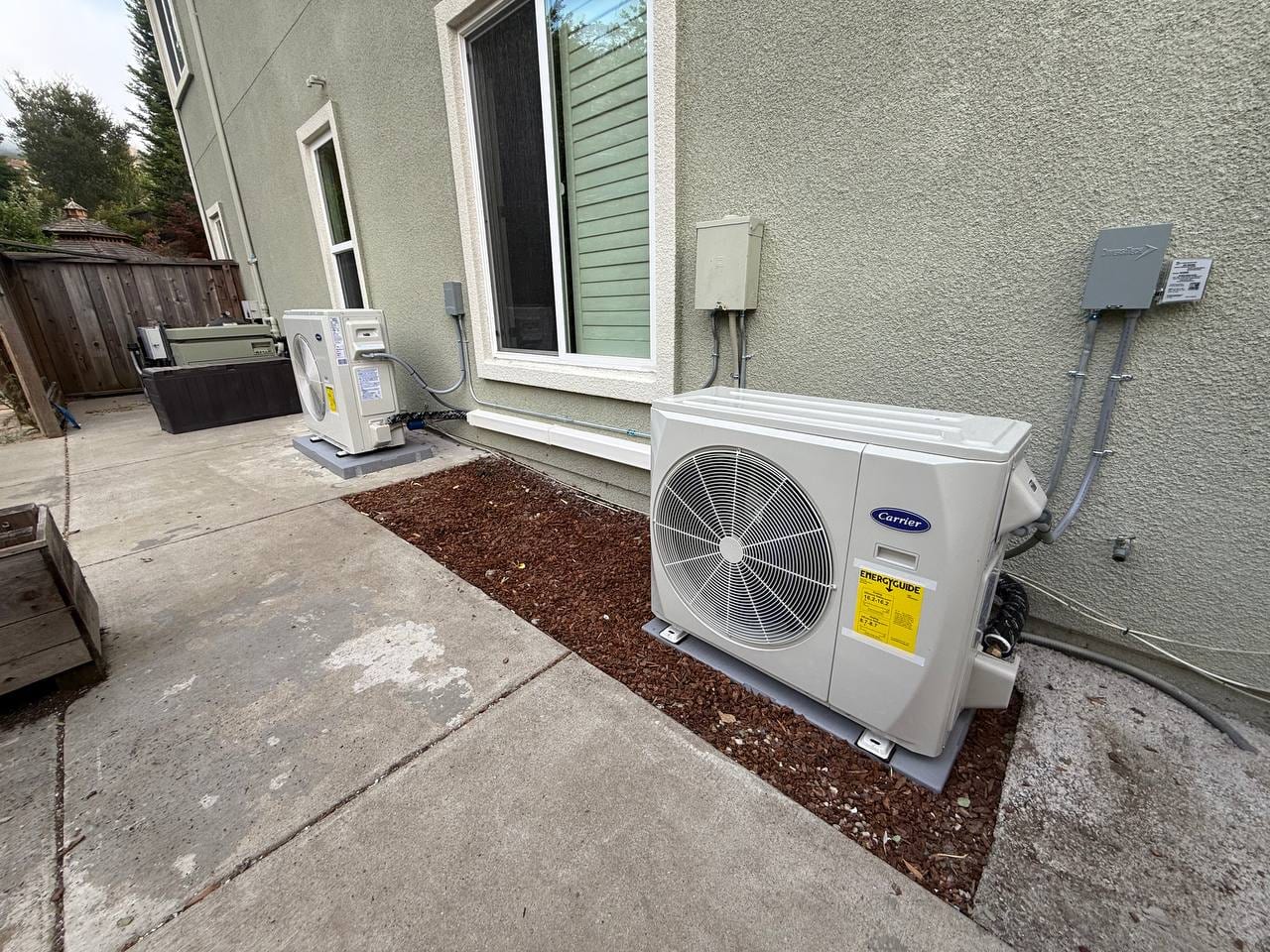
Carrier and Trane are both premium HVAC brands, split on parts, not quality. Carrier shares a parts catalog with Bryant, so components stay stocked and repairs run cheaper and faster. Trane’s heavier outdoor unit and Climatuff compressor rarely fail, but its high-end boards cost more and take longer to source. Pick Carrier for parts access, Trane for the heaviest build.
Carrier and Trane both have a cheaper twin
Before comparing the two, know that each brand has an identical sibling sold for less. Carrier and Bryant are the same equipment under two badges. Trane and American Standard are the same equipment, built on shared platforms in the same plants. So if a contractor quotes you a Bryant against a Carrier, or an American Standard against a Trane, the machine is the same and the difference is the label and the price. That is worth knowing before you pay the premium-badge markup.
Engineering and build
Trane built its reputation on heavy equipment, and it is earned. The Climatuff compressor and the heavier-gauge cabinets mean a Trane condenser tends to outlast lighter units in the same conditions. The coils and cabinets hold up. Carrier is also well built, and the engineering is sound across the Infinity and Performance lines. The practical edge I give Trane is raw outdoor-unit durability. The edge I give Carrier is parts availability, which I will get to, because a durable unit you cannot get a board for fast is its own kind of problem.
Parts availability and repair cost
This is where the two separate for me. Carrier parts are widely available, and because Carrier and Bryant share a catalog, sourcing is rarely the holdup. That matters in July when your AC is down and you do not want to wait a week.
Trane parts cost more, and the proprietary side bites on the higher-end lines. The communicating and variable-speed systems use Trane’s own controls and boards. A failed variable-speed blower module or a communicating thermostat board is a real bill, and lead time can run longer than a standard part. On single-stage and two-stage Trane units, parts are sensible and repairs are routine.
Carrier has its own version of this. The Infinity boards and communicating controls cost real money when they fail, and they demand a tech who reads fault codes rather than swapping the most expensive part on a guess. We diagnose by code on both brands.
Quick comparison
| Carrier | Trane | |
|---|---|---|
| Engineering | Sound, well built, Infinity/Performance lines. Same as Bryant. | Heavy build, Climatuff compressor, long-lived outdoor units. Same as American Standard. |
| Parts availability | Wide. Shared Carrier/Bryant catalog, fast sourcing. | Good on standard units. Proprietary boards on high-end lines can run longer lead times. |
| Typical repair cost | Depends on the failed part. Infinity boards cost more. | Slightly higher on average. Communicating modules and boards are the expensive outliers. |
| Efficiency | Strong, up to high-SEER2 heat pumps and 19 SEER systems we have installed. | Strong, comparable ratings across matched systems. |
| Reliability and serviceability | Durable, very serviceable, code-driven diagnosis. | Very durable hardware, serviceable on base lines, pricier on proprietary parts. |
| Best for | Homeowners who want premium with the easiest parts access. | Homeowners who want the heaviest build and plan to keep it 15-plus years. |
Efficiency
Both brands reach high efficiency in matched systems. We installed a two-zone Carrier 19 SEER heat pump in San Ramon that replaced two dead R-22 air conditioners, and it performs to its rating because it was sized and charged correctly. Trane hits comparable numbers on its matched variable-speed systems. At the same efficiency target, you are choosing on build and parts, not on the rating sticker.
Reliability and serviceability
What we actually see fail tells the truth. On Trane it is hot-surface ignitors and flame sensors on the furnaces, condenser-fan motors and run capacitors outside, contactors, and charge issues that trace back to the original install. The Climatuff compressor rarely dies on its own. When one is failing it is usually downstream of a low charge or an old electrical fault nobody caught.
On Carrier the pattern is similar. We did a Carrier furnace repair in Pleasanton on a unit that ran ten years with no service at all. It still fired. The weak flame sensor, the worn ignitor, and the dust-packed blower wheel were a maintenance gap, not a Carrier defect, and the fixes were standard parts on the truck.
The lesson on both brands is the same. A premium unit only performs to its rating when it is sized with a Manual J load calculation and the charge is weighed to the nameplate. Oversize it or leave it short on refrigerant and even good equipment short-cycles and underdelivers. Install quality decides lifespan more than the badge. Our HVAC installation work is built around that, and you can see the broader pattern in our Bay Area HVAC reliability report.
Who each brand is best for
Pick Carrier (or Bryant to save on the badge) if you want premium equipment with the easiest parts access and fast repairs when something fails. Pick Trane (or American Standard to save on the badge) if you want the heaviest build and you plan to keep the system 15 years or more, and you accept that proprietary parts on the high-end lines cost more.
Either way, ask for the parts cost in writing before anything is ordered, and ask whether the new system was sized with a load calculation. Those two answers predict satisfaction better than the brand name.
We service both through our division, Bay Area HVAC Service. Installs carry our 10-year parts warranty; labor is 2 years standard, extended to 10 years with our maintenance plan. Repairs carry one year, and the $99 diagnostic is credited toward the repair. We do not steer you toward one badge to suit us. We repair and install Carrier and we repair and install Trane, sized and charged to spec, with a written quote before we touch anything.