When a refrigerator stops cooling or a range won’t light, you’ll usually get three kinds of offers. An appliance repair company. An HVAC contractor who “does appliances too.” And a handyman who can be there this afternoon. All three can be honest, capable people. They’re set up for different work, and picking the wrong one usually costs a second visit or a part you didn’t need. Sometimes it costs the warranty.
What changes when a company works on appliances every day
The uniform and the wrapped van don’t tell you much. What’s on the parts shelf and on the laptop does, and so does a tech who’s already done the job a few hundred times.
Parts by model number, not by what looks right
Manufacturers change parts mid-production without changing the model name. Two refrigerators sold the same year under the same model number can carry different control boards, fan motors or gaskets depending on the serial range. The right part is found by model and serial number in the manufacturer’s parts system, then checked against the service bulletins for that range, because the replacement is sometimes a superseded part with a new number and an adapter plug.
A shop that does this daily has accounts with the appliance parts distributors, knows which parts are non-returnable once opened (control boards almost always are), and knows which ones are on backorder before it promises a date. A tech who buys a part that “looks the same” from a general supplier is guessing, and a guessed board that doesn’t fix it is money gone.
Sealed systems and inverter boards
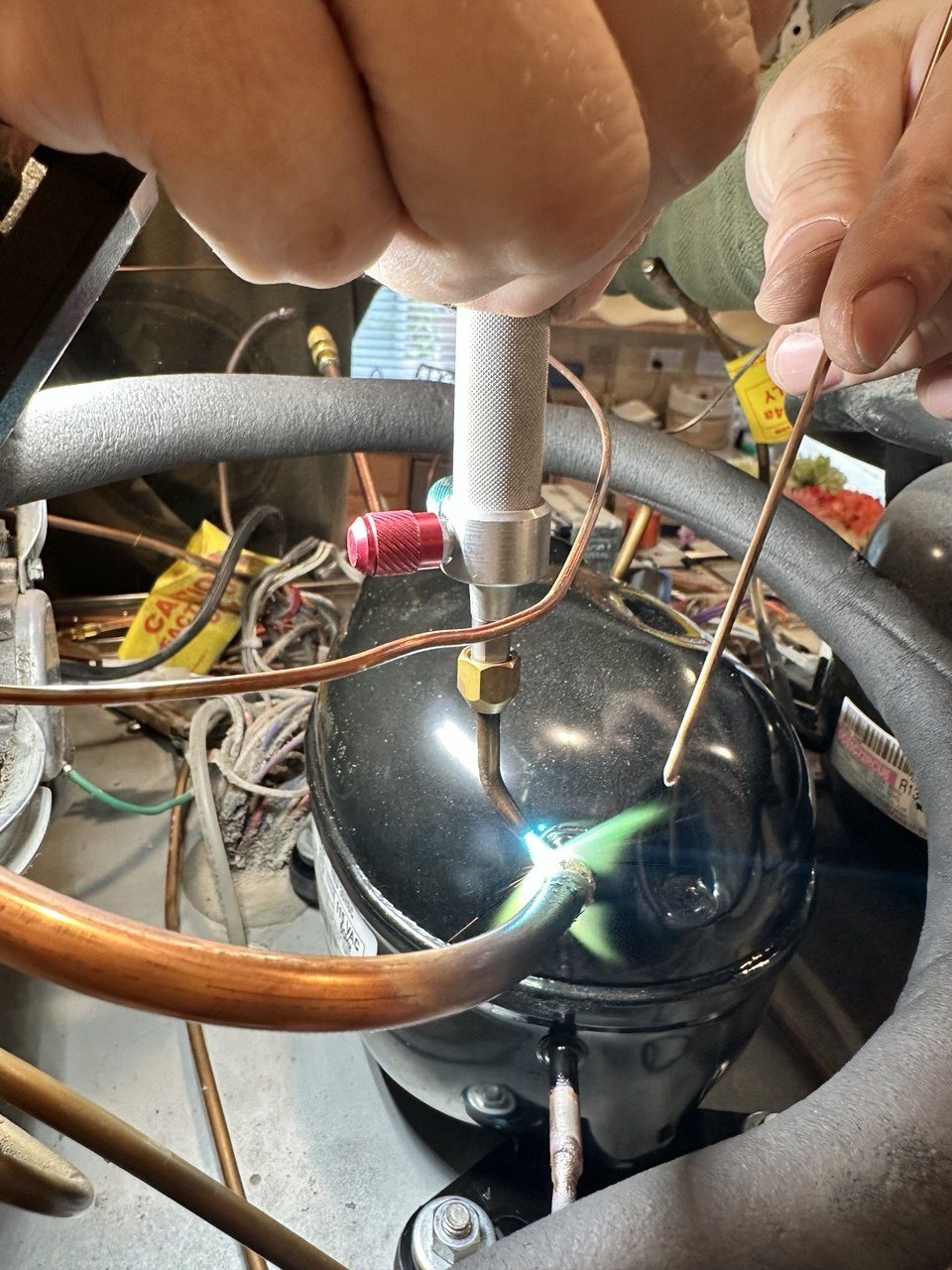
A refrigerator that runs but never gets cold can be a fan, a defrost fault, a control, a compressor, or a refrigerant loss. The last two are sealed-system work: recover the refrigerant, braze in a new compressor, filter drier or evaporator, pull a deep vacuum, then weigh in a charge measured in ounces. Newer refrigerators run on small charges of R600a, which is flammable, so the tools and the procedure are different from residential air conditioning, and the safety training is its own credential.
Then there are inverter compressors. Most current refrigerators and a lot of washers drive the motor through an inverter board. A failing compressor and a failing inverter board produce the same symptom, and the way to tell them apart is the manufacturer’s test procedure with the right meter, in the right order. Replace the board when the compressor was the problem and you’ve paid for the board and still have a warm fridge.
Brand documentation and diagnostic discipline
Every major brand puts a tech sheet behind the kick plate or inside the control panel, and behind that sit service manuals, fault-code tables and hidden diagnostic modes you only reach with a key sequence. Sub-Zero, Viking, Miele, Whirlpool and LG each do it differently, and the sheet tells you what a code means for that model, not for the brand in general.
Diagnostic discipline is the boring part. Read the fault log before touching anything. Confirm the complaint. Test the suspected part against spec. Write down what was found before quoting. We covered what the $99 diagnostic covers in its own post; the short version is diagnose first, then quote.
What an HVAC-only shop is set up for
An HVAC contractor’s day is furnaces, air conditioners, heat pumps, mini-splits, ductwork and thermostats. The refrigerant work is real and skilled, but it’s a different scale: line sets, charges measured in pounds, a condenser outside and a coil in the attic. Parts come from HVAC distributors, and the training is furnace boards, capacitors, contactors, blower motors and refrigerant circuits sized for a house.
What that shop usually isn’t set up for: a fridge sealed system with a few ounces of charge and capillary-tube metering, a range with a spark module and a gas valve under the cooktop, a dryer’s moisture sensor and motor relay, a washer’s inverter drive. Not because the tech isn’t sharp. The parts accounts, the tech sheets, the brazing setup for small copper and the diagnostic procedures are all different, and a good HVAC tech knows it and will tell you so.
The reverse is just as true. An appliance-only company has no business on your roof at a condenser. ADRIUM runs both sides under one roof, Daikin and Mitsubishi factory-trained on the HVAC side. If you’re not sure where your problem belongs (a garage fridge or a wine column is appliance, a walk-in cooler is commercial refrigeration, a heat pump is HVAC), the services page lays out who takes what.
Where a handyman is the right call, and where the risk starts
Fine for a handyman
Cosmetic and simple mechanical work: a door handle, a drawer glide, a broken hinge, leveling a fridge or washer, reversing a fridge door swing, a range hood bulb or mesh filter, a dryer knob, drip pans, the water filter you’ve been putting off. A garbage disposal swap belongs with a plumber or a handyman, not with us. Those jobs need a competent person with hand tools, and a handyman is usually cheaper and faster for them.
Where to stop
Four places the risk starts.
Gas. Igniters, gas valves, orifices, regulators, the flex connector behind the range. A slow leak or a delayed ignition isn’t something to learn on in somebody’s kitchen.
Refrigerant. Federal law under Section 608 of the Clean Air Act requires certification to open a refrigerant circuit, and venting it is a violation. Anyone offering to “top off” your fridge without recovery equipment should not be near it.
High-voltage boards. Inverter boards, microwave capacitors and induction modules hold a charge after the plug is pulled. They’re also the parts that can’t be returned once installed.
Warranty. Most manufacturer warranties require a qualified servicer, and premium brands often require an authorized one. A well-meaning repair by an unregistered person can end a warranty you paid for. California also requires appliance repair businesses to register with the state, and asking for that number is a fair question.
Who to call, by problem
- Fridge not cooling, freezer frosting over, ice maker dead: appliance specialist.
- Burner won’t light, oven not heating, oven error code: appliance specialist.
- Washer not spinning, dryer not heating: appliance specialist. A dryer that takes two cycles is often a restricted vent; we diagnose the restriction on the call and refer the cleaning itself to a vent specialist.
- Furnace, AC, heat pump, mini-split, thermostat, ducts: HVAC contractor.
- Walk-in cooler, reach-in, ice machine, espresso machine: commercial refrigeration and coffee specialist.
- Handles, hinges, leveling, door swing, bulbs, filters, disposal: handyman or plumber.
What ADRIUM holds, in plain words
Since this whole post is about credentials, here are ours. BEAR registration #50788 for appliance repair in California. CSLB license #1136642. EPA Section 608 Universal certification, and HC(A3) & HFO(A2L) certified technician for the flammable refrigerants in newer equipment. On the appliance side we work on Sub-Zero and Viking built-ins as an independent shop with genuine parts. La Marzocco authorized, factory-trained, on the commercial coffee side. Daikin and Mitsubishi factory-trained on HVAC. The about page has the paperwork.
Owner-operated. Andrew stands behind every job: the work, the invoice, and the warranty. Appliance repairs carry a warranty from 3 months to 2 years depending on the type of repair. The $99 diagnostic is credited toward the repair, which makes it a $0 service call with a completed repair. Same or Next-Day Service for appliance and HVAC visits across the Bay Area.
And if the diagnosis says the honest answer is a new machine, we’ll say so. The rules we use are in repair or replace: the rules we use on every service call.