
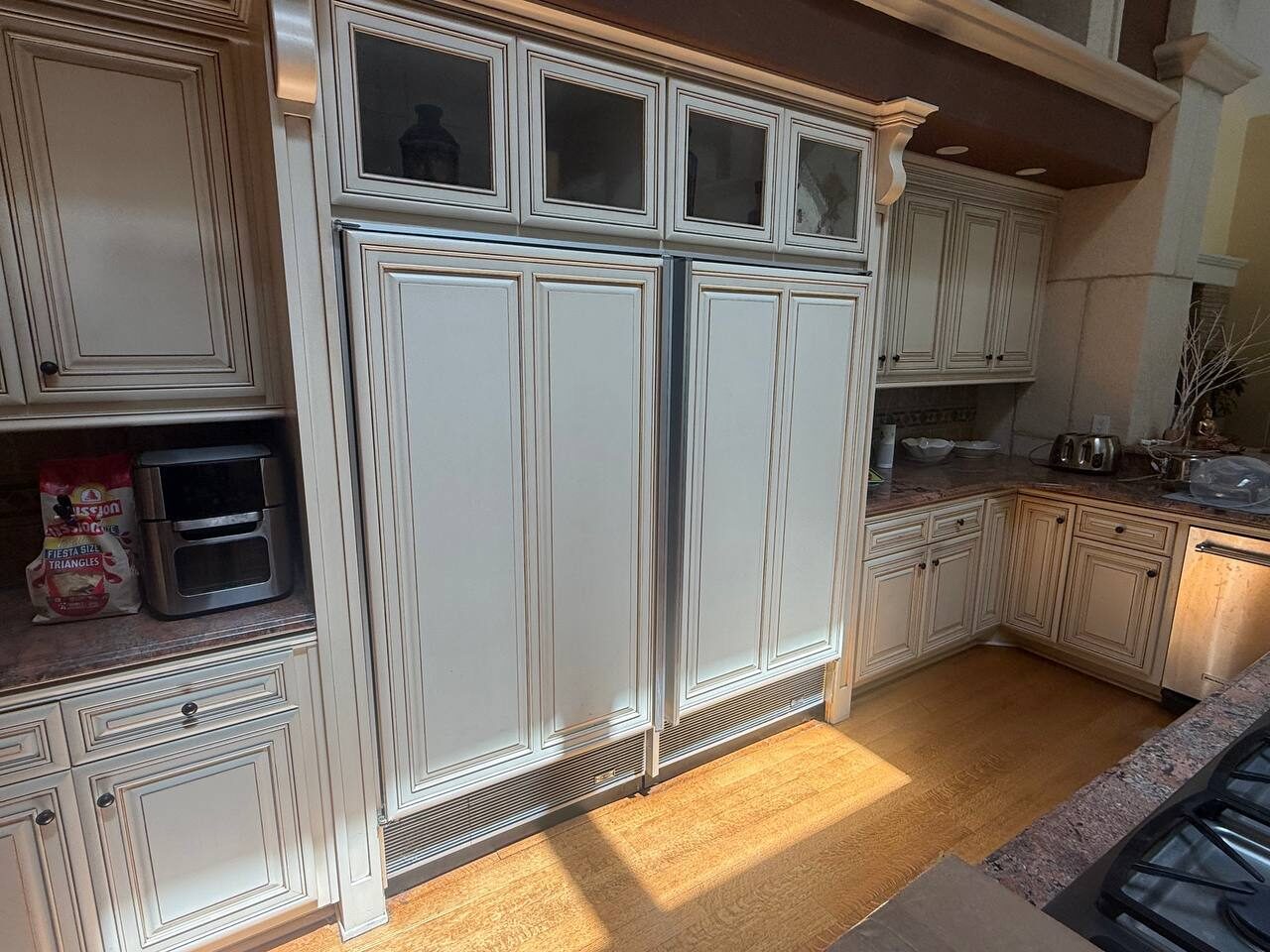
Drive from the coast to Livermore on a July afternoon and you feel it the moment you step out of the car. Pleasanton, Dublin, San Ramon and Danville sit on the inland side of the hills and run hotter than the coast for weeks at a stretch. Your refrigerator feels that too, and anything that was already marginal in May tends to show up in a hot week.
Why inland heat hits a refrigerator harder
A refrigerator is a small heat pump: the condenser coil sheds heat into the room, and the evaporator inside the box picks it up from your food. The condenser can only shed heat if the air around it is cooler than the coil. In a kitchen already warm from the afternoon sun and the oven, that difference shrinks and the compressor runs longer to hold the same temperature.
Longer run time on its own is not a fault. It becomes one when something else is adding to the load: a dusty coil, a gasket that leaks, a condenser fan that’s getting tired. Any of those costs you a little all year. In a hot week they add up to a soft freezer or a fresh-food section that creeps warm.
The summer checklist
1. Clean the condenser coils
This is the most useful thing you can do. Dust, pet hair and cooking grease pack into the fins like a blanket over the one part that’s supposed to shed heat.
Where the coil lives depends on the model. On most Sub-Zero built-ins it’s behind the top grille. On many freestanding refrigerators and some built-ins it’s at the bottom behind the toe-kick, or on the back. The Sub-Zero condenser cleaning guide covers that brand’s layout; for anything else, check the manufacturer’s care page.
Unplug the unit or switch off the breaker first; the condenser fan runs with the compressor. Pull the grille, brush the fins in the direction they run with a soft condenser brush, vacuum what comes loose, and get the fan blades while you’re in there. No water, no chemicals, no bent fins. Give it a day to settle before judging temperatures.
With pets or a lot of cooking next to the fridge, the coil loads up faster. Check it at the start of summer and again in the fall.
2. Check the door gaskets
Warm, humid air leaking past a gasket makes the compressor run longer and dumps moisture onto the evaporator, where it turns to frost. Look along each gasket for folds or splits, and for food residue in the channels. Wipe it with warm water and a little dish soap, then dry it. Close the door on a sheet of paper at a few spots; if it slides out with no drag, that section isn’t sealing.
Look at the door itself too. A jar on the shelf edge or a bin out of its track can hold a door open a crack for hours, and on a panel-ready built-in a heavy custom panel can pull the door out of alignment over time. Don’t heat a gasket to reshape it, and don’t adjust hinges on a built-in yourself. A tech can align the door and replace a gasket that’s done.
3. Give it room to breathe
A freestanding refrigerator needs the clearance the manual specifies at the back, top and sides so the condenser can move air. Boxes on top, a cabinet pushed tight against the side, or a rug bunched in front of a toe-kick grille all cut that airflow. Built-ins sit tight by design, but the front grille still has to be open; a dog bed parked against it counts as a blockage.
Inside, don’t pack food against the vents that move cold air from the freezer to the fresh-food section. A blocked vent shows up as a warm fridge with a cold freezer.
4. The garage refrigerator
The second fridge in the garage is the one most likely to struggle in a Tri-Valley summer. Household refrigerators are designed for a range of indoor room temperatures, and the manual lists it. A closed garage on a hot afternoon can sit well above anything the kitchen sees, so the unit is fighting a much bigger difference between inside and out.
What that looks like: the compressor runs almost continuously, the freezer drifts soft, ice slows or stops, and the cabinet feels hot. None of that necessarily means a part failed; the location may simply be outside what the appliance was built for.
Keep it off the sunny wall and away from the water heater or dryer. Leave more clearance than the minimum, ventilate the garage on hot days, and clean the coil more often than the kitchen unit, because garages are dusty. Some manufacturers sell models rated for garage use; if yours isn’t one, the manual says so.
5. Ice maker load
Summer empties the ice bin faster, and a slow ice maker is usually the first thing people notice. A full bin stops production normally, and a warm freezer slows it because the mold takes longer to freeze. An old or partly seated water filter restricts the fill. Check those before you blame the ice maker itself, and don’t force a harvest cycle or pour hot water into the mechanism.
If it only keeps up after the fridge rests overnight, the freezer is struggling, not the ice maker.
What the noises mean
A refrigerator working hard in a heat wave makes more noise than usual, and most of it is normal. Some of it isn’t.
- Gurgling or trickling after the compressor shuts off is refrigerant equalizing. Normal.
- A click every few minutes followed by silence, with no cooling, is the compressor trying to start and tripping off. That’s a start relay, an overload, or the compressor itself. Call.
- A rattle or buzz from the bottom rear that changes when you press on the cabinet is often the condenser fan hitting something, or a fan motor with a worn bearing.
- Scraping or chirping from inside the freezer that stops when you open the door is the evaporator fan hitting frost, which points to a defrost problem, not the fan.
- A new loud knock or grind from the compressor area is not something to wait out.
When a warm fridge is an emergency
Not every warm fridge is urgent.
Call right away if the freezer is softening and the fresh-food side is warm at the same time, if the compressor clicks but won’t run, if the cabinet is hot and you smell something burning, or if the breaker trips again after a reset. Keep the doors closed while you wait. If it’s the burning smell or the breaker, unplug the unit and don’t keep resetting it to see whether it comes back.
A fridge that’s warm while the freezer stays cold is almost always airflow, a stuck damper, or a defrost fault. It can usually wait a day, and the refrigerator not cooling page walks through what a tech checks first. A temperature alarm on a Sub-Zero or Thermador built-in that won’t clear after you’ve cleaned the coil and checked the door needs a look, not another reset.
Don’t buy a can of refrigerant. A sealed-system leak needs EPA-certified handling and the right equipment; ADRIUM holds EPA #1279674151528 for that work. A DIY charge won’t fix a leak and can take out the compressor.
What a visit looks like
We book Same or Next-Day Service for appliance visits across the Tri-Valley, from Pleasanton to Livermore, Dublin, San Ramon and Danville. The $99 diagnostic is credited toward the repair if you go ahead, which makes it a $0 service call with a completed repair. The estimate is in writing before any work starts, and repairs carry a warranty from 3 months to 2 years, depending on the type of repair. Refrigeration repair covers built-in columns, French-door units, wine reserves and undercounters, with sealed-system work done in-house.
Call (925) 999-4095. We’re open 7 AM to 7 PM, seven days a week, and during those hours we return calls within about 10 minutes. Andrew stands behind every job: the work, the invoice, and the warranty.