
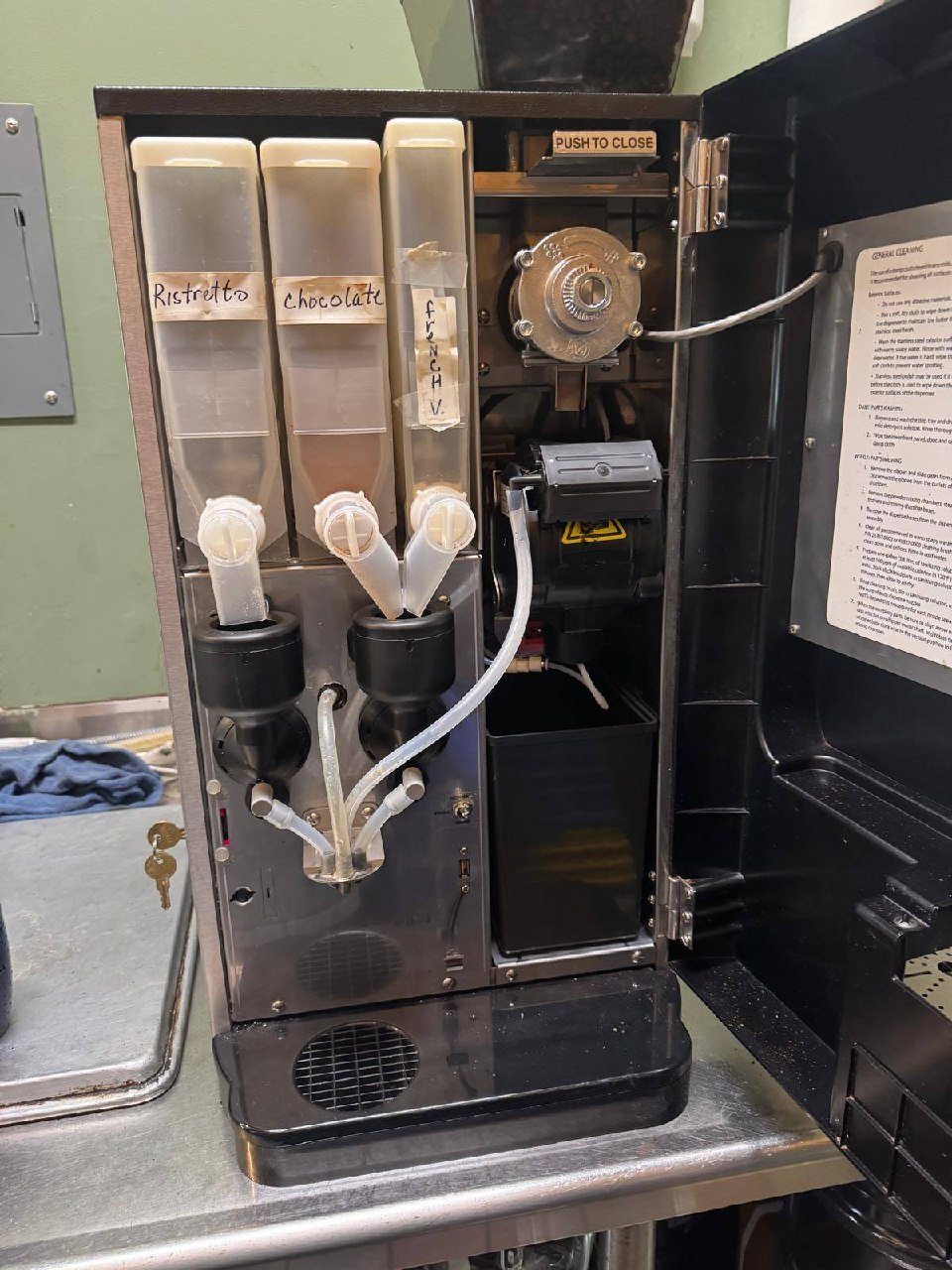
Tribu Grill, a Union City restaurant, runs a Bunn Crescendo for their coffee. It grinds, doses, brews and mixes one cup at a time, and by July it had started leaking whenever it ran. The mixer was backing up too. Nothing was dead. The machine still poured, just not cleanly.
That pattern, a working machine that has quietly become a mess, is the most common way a bean-to-cup unit tells you the annual kit is overdue.
What wears out inside a bean-to-cup machine
A Crescendo does every step itself: grind, dose, brew, dispense, rinse. Hot water and coffee oils pass through the same soft parts hundreds of times a day. Valve diaphragms, seals, O-rings and silicone lines all age from that, and none of it shows from the outside. The silicone stiffens and turns brown. The diaphragms stop closing all the way. Then one morning the drip tray is full and nobody dispensed anything.
Bunn sells the wear parts for this model as a preventive maintenance kit, meant to go in about once a year. That’s the “annual PM kit” you’ll hear technicians mention. It isn’t an upsell. It’s the set of parts designed to be replaced on an interval, the way a car has a schedule for belts and filters.
The warning signs
What we see on Crescendos and similar machines when the kit is overdue:
- Water or coffee under or behind the machine, or a drip tray that fills faster than it should.
- The mixer backing up: powdered products like chocolate not clearing the mixing chamber, clumping, or spitting back.
- Drinks that vary cup to cup, weak one time and short the next, with no change in settings.
- Rinse cycles that take longer, or a machine that asks for cleaning more often than it used to.
- Coffee dust packing in around the grinder. The grinder path on this machine collects fine grounds, and it needs to come out with the kit.
Any one of these can have another cause. Two or three of them together on a machine that hasn’t had its kit in a year usually points at the soft parts.
What the Crescendo maintenance covers
The tempting fix is to swap the one line that’s visibly dripping. The other lines are the same age and the same silicone, so the next leak is already on its way. That’s why the recommendation after the July diagnostic at Tribu Grill was the full maintenance, hoses and gaskets included, with the parts ordered rather than patched.
The kit went in on September 1. What that involved:
- Valve diaphragms replaced. These control water flow to the brewer and mixer; a tired diaphragm weeps or sticks.
- Seals and O-rings replaced throughout the brew path.
- All silicone lines replaced.
- Brewer and grinder path stripped and deep-cleaned, including the grounds packed in around the grinder.
- Full brew cycles run before we called it done, and the machine back in service the same visit.
Not glamorous. But a rebuilt brew path is one visit. Chasing leaks one line at a time isn’t.
My opinion, for what it’s worth: on a machine that pours all day, put the kit on the calendar and don’t wait for the leak. If your Crescendo only pours a handful of drinks a day, you can stretch it, and you’ll get a warning from the drip tray and the mixer first. On a busy line I wouldn’t.
How the service works for a restaurant
Bunn coffee brewers connected to building plumbing are diagnosed on site for $99, credited toward the repair. Countertop coffee brewers come to our bench; we confirm the bench price when you book. Bunn slush and frozen-beverage machines receive a $99 on-site diagnostic credited toward the repair, with a warranty from 3 months to 1 year depending on the repair.
For countertop machines that come to the bench, diagnostics can take up to a week, and most repairs run 3 to 4 weeks, mostly waiting on parts. That is exactly why we recommend preventive maintenance: a maintained machine does not sit in a repair queue for a month.
A built-in bean-to-cup unit on a restaurant line is handled a little differently. The Crescendo at Tribu Grill was diagnosed on site in July. The parts were ordered, and the kit went in on a second visit once they arrived. We agree the timeline up front and tell you as soon as anything about it changes, parts delays included.
What the customer said
Eric at Tribu Grill left this on our Google profile: “We have a Bunn Crescendo that wasn’t operating properly. They determined it needed an annual PM kit and now it is running well”.
That’s the whole review, and it’s the right summary. The job wasn’t exotic. It was the scheduled maintenance the machine had been asking for since July.
The full write-up lives on our coffee division’s site: Bunn Crescendo bean-to-cup repair in Union City.
If your machine is doing this
If a bean-to-cup machine in your restaurant, cafe or break room is leaking, backing up, or pouring inconsistent drinks, and nobody can remember when the kit last went in, make the call before it stops entirely. Our commercial coffee machine repair page covers what we take and how to book.