
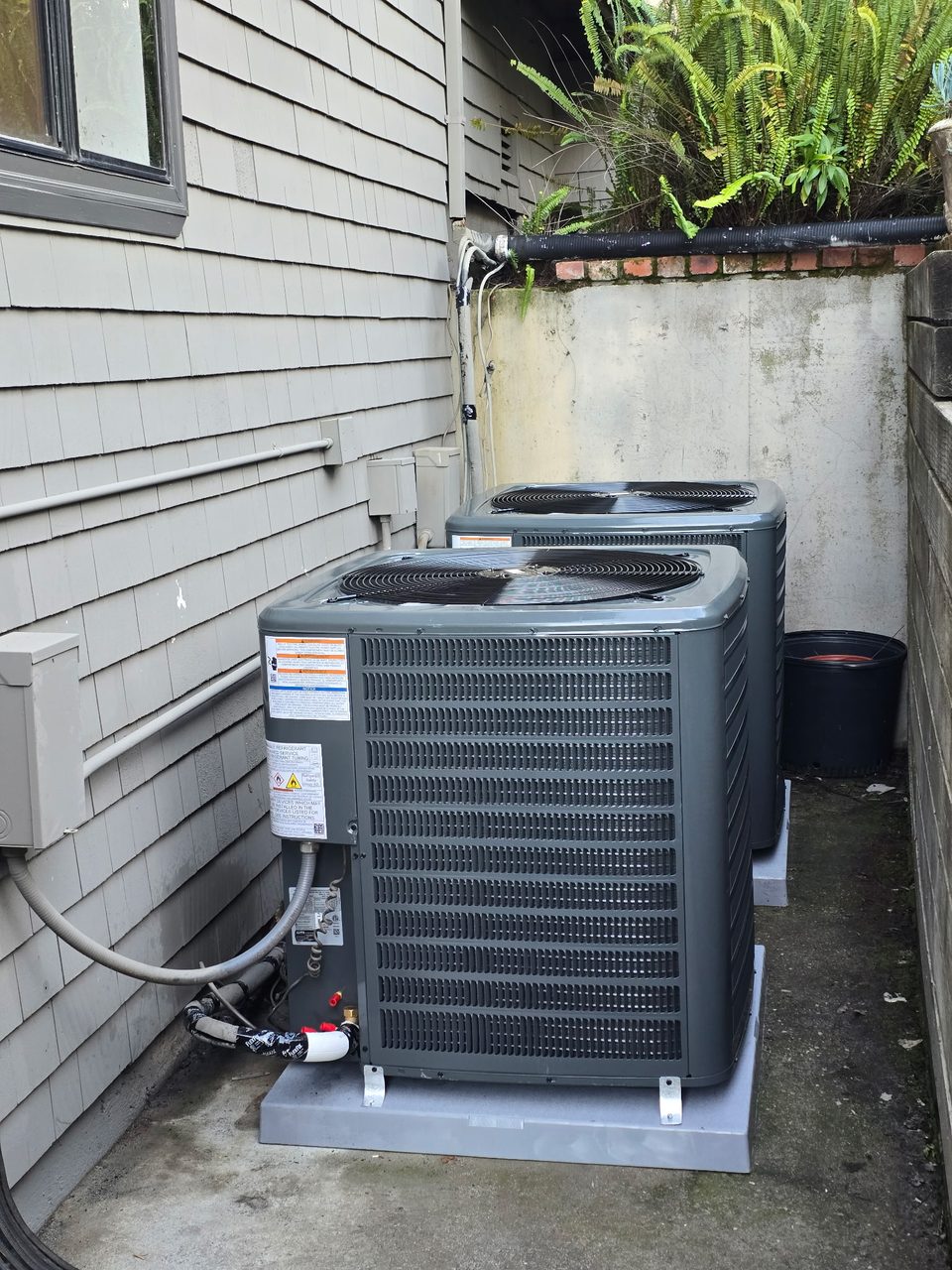
When a customer asks me to quote a new furnace or AC, the first thing I do is not pick a brand or a tonnage. I figure out the load. The load is the amount of heat a house gains on a hot afternoon and loses on a cold morning, measured in BTU per hour. Every real size starts there. Get the load right and the equipment choice almost makes itself. Get it wrong and even a top-tier Daikin or Mitsubishi unit will run badly. This is what that calculation is actually doing, written so a homeowner can follow it.
The load is a number, not a guess
A load calculation answers one narrow question. How much capacity do you need to hold the indoor target when the weather outside is at its design value. I calculate that number first, then I look for the nearest standard equipment size that covers it. Equipment comes in steps: 2 ton, 2.5 ton, 3 ton, and so on. The skill is keeping the gap between your calculated load and the next size up small and on purpose, instead of rounding up “to be safe” and landing a full ton over.
That rounding-up habit is where most of the oversized systems in the Tri-Valley come from. An oversized AC short-cycles, never runs long enough to pull moisture out of the air, and wears its compressor faster. Bigger is not a safety margin. It is a comfort and reliability problem you pay for every month.
Heat coming in is not the same as cooling load
This is the part that separates a real calculation from a chart. Heat enters a house two ways. Convective heat, like warm air leaking through gaps, becomes a load almost the instant it arrives. Radiant heat, like sun hitting a tile floor or a wall warming through the afternoon, gets soaked into the mass of the building and released hours later.
So the heat that pours in at 2 PM does not all show up as a cooling load at 2 PM. Part of it is stored in the structure and re-radiated into the evening. The result is that your peak cooling load lags and flattens out compared to the peak heat gain. The proper methods account for that storage and delay. A square-foot shortcut does not. Heating is simpler. I treat heat loss as instantaneous, so the loss at the cold design temperature feeds straight into the furnace or heat pump size.
We size to the design temperature, not the record day
Here is the mistake I correct most often. We do not size for the hottest day ever recorded. We size to a frequency-based design value. The cooling design temperature is the number your area exceeds only about 1 percent of the hours in a year, which is roughly 88 hours. The heating design value is the 99 percent number, the temperature it drops below only about that often. ASHRAE publishes these from real weather-station records.
In our service area that spread is wide. The cooling design value runs near 81 degrees on the East Bay coast, around 88 to 90 in the South Bay, and up near 99 inland through the Tri-Valley and Diablo Valley. Heating design values land roughly between 30 and 36 degrees. Indoor targets are about 75 cooling and 70 heating. That is why a house in Alamo and an identical house in San Ramon do not always get the same system. Building for a two-hour record peak that happens once every few years oversizes the equipment for all 8,700 normal hours.
Where the load actually comes from
Both the heating and cooling numbers break into the same handful of sources, and knowing them lets me tell a customer exactly what is driving their tonnage.
- Conduction through the envelope. Heat moving through walls, ceiling, floor, windows, and doors. For each surface the rate is area divided by R-value, or area times U-value for glass. This is why insulation and window quality swing the number so hard.
- Solar through glass. Set by glass area, the solar heat gain coefficient, shading, and which way the window faces. West and southwest glass drives the late-afternoon peak. North glass barely matters.
- Sol-air on the roof and walls. The sun heats opaque surfaces well above the air temperature, so conduction through a dark roof over an attic runs on a much bigger effective difference. A real calc includes it.
- Air leakage and ventilation. Infiltration through cracks plus any mechanical ventilation on tight newer homes. Outdoor air brings both a temperature load and a moisture load.
- Internal gains. People, lights, appliances. Each person adds roughly 250 BTU per hour of sensible heat plus moisture.
Sensible and latent are two different jobs
Cooling does two things at once. Sensible load is dropping the air temperature. Latent load is pulling out moisture. The coil handles both, and the total is the sum. This is the real reason oversizing leaves a house cold and clammy. The unit hits the thermostat setpoint so fast it never runs long enough to dehumidify. Our dry inland climate keeps the latent load small, so most of our cooling is sensible. That is exactly why I refuse to pad the number. Heating is sensible only.
The methods, crude to correct
Square-foot-per-ton is the phone-call ballpark. Floor area divided by a fixed ratio. It is fine for telling someone they are looking at a 3-ton versus a 4-ton range before anyone has measured anything. It ignores orientation, glass, insulation, leakage, occupants, and one-story versus two-story. It is never the basis for an install.
CLTD/CLF is the practical manual method. It applies pre-computed temperature differences that already bake in the sol-air and storage effects, so it captures the heat-gain-is-not-load reality without an hour-by-hour simulation.
Manual J is the residential procedure that sizing should rest on, with Manual N for commercial work. It builds the load from first principles, room by room, and produces a defensible cooling and heating number for the whole house. Manual J is required on every California HVAC permit, so if a contractor hands you a quote with no load calc behind it, that is a flag.
How to get a real number for your house
You do not have to run any of this by hand. When we come out for an installation estimate, we run a full Manual J on site, measure your envelope and glass, and give you a written quote with the load behind it. Our $99 diagnostic is credited toward the repair. Installs carry a 10-year parts warranty plus a labor warranty (2 years standard, extended to 10 years with our maintenance plan). One note on incentives so nobody plans around bad information. The federal 25C heat-pump tax credit expired December 31, 2025, and California’s Tech Clean rebate program is closed to new applicants, so I confirm what is actually paying at estimate time rather than quoting a number that may be gone.
ADRIUM handles both appliance and HVAC work, and the deep HVAC design and sizing focus lives in our dedicated division, Bay Area HVAC Service, where the load-calculation tools and the full Manual J workflow live. Here is the one-line version of all of it. The design temperature already drops the rare extreme days, and the load calc already accounts for your specific house, so adding a safety margin on top is just oversizing a system you then run poorly the rest of the year. I size to the load.