
A walk-in freezer that drifts above zero is a countdown, not a fault code. Frozen product holds for a while, then it does not, and the loss adds up faster than the repair bill. This guide covers what actually breaks, what to observe before calling, and when to pick up the phone.
The most common walk-in freezer failures
Iced-over evaporator coil. If the inside coil is buried in a solid block of frost, air cannot move across it and box temperature climbs even though the compressor runs. The cause is almost always a defrost failure: a dead defrost heater, a stuck defrost timer or control board, or a failed termination thermostat. The freezer keeps freezing, but it freezes itself shut.
Dirty or blocked condenser coil. The coil on the condensing unit dumps heat. In a busy kitchen it cakes with grease and dust. A choked coil makes the compressor run hot and long, kills efficiency, and eventually trips on overload. This is the single most preventable failure we see.
Failed condenser or evaporator fan motor. No airflow over a coil means no heat exchange. A seized evaporator fan lets the coil ice up. A dead condenser fan makes the system overheat and short-cycle. You can often hear it: silence where a fan should be humming.
Door and gasket problems. A torn gasket, a sagging door, or a closer that no longer pulls the door shut lets warm humid air pour in. That shows up as heavy frost near the door, sweating walls, and a unit that runs constantly to keep up.
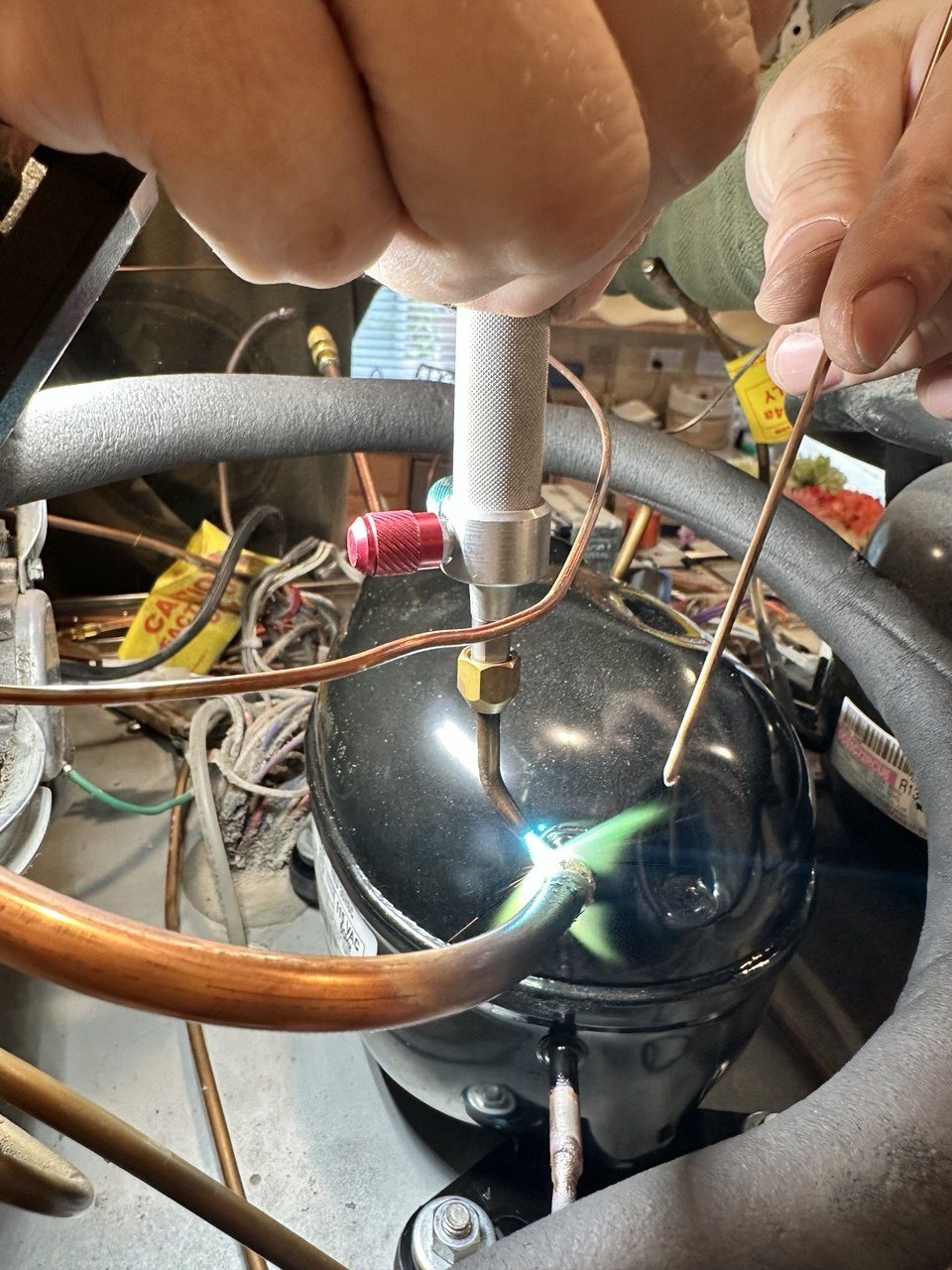
Refrigerant leak or compressor failure. When charge drops, the freezer struggles to reach temperature and the suction line may frost oddly or not at all. A compressor that hums and trips without starting is locked up. Both are sealed-system work and require EPA-certified handling. This is the expensive end and not a DIY zone.
What to note before you call
First: if the box is climbing past 10°F and still rising, start moving your most valuable product to another freezer now. Do not wait on the repair to make that call.
Once product is safe (or safe enough), these are the four things worth checking yourself:
- Temperature and trend. Is it rising steadily, or did it spike and stabilize? Note the current reading.
- Door seal. Run your hand around the gasket for cold leaks. Does the door pull shut and seal on its own?
- Fan noise. Are fans audible at both the evaporator (inside) and the condensing unit (outside)? Silence where you’d expect a hum is a useful clue.
- Breaker. If it tripped, one reset is fine to confirm. If it trips again, leave it off. Do not keep cycling a potentially locked compressor.
That information tells the technician where to start and saves diagnostic time on the call.
Why the rest is a pro job
Past those four checks, walk-in freezer work requires certification, specialized tools, and live electrical testing. Diagnosing a defrost system means checking heater continuity, timing, and termination thermostat logic under load. Fan motor replacement requires verifying amp draw and capacitor sizing so the motor does not burn out again. Condenser coil service on commercial equipment means working around refrigerant lines. Sealed-system work (refrigerant, compressor, brazing) is EPA-regulated and cannot be done legally without certification.
Cycling a failing system over and over to “keep it going” is how a fan-motor job becomes a compressor job. Catching it early is almost always the cheaper path.
Call us
Walk-in freezer down with product inside is an emergency. Call (925) 999-4095 or email welcome@adriumservice.com and tell us it is down with product. We prioritize commercial refrigeration calls, aim for same or next-day arrival, and tell you straight if there is a delay so you can move product in time. You get a written estimate before we order anything bigger. The $99 diagnostic is credited to the repair when you book it.
We cover the Bay Area, founded in 2021, CSLB #1136642 (C-20 HVAC), EPA certified (#1279674151528), BEAR registered (#50788), and BBB A+ rated.
For deeper background, see our commercial refrigeration repair guide and our full commercial appliance repair overview. If your space is a walk-in cooler rather than a freezer, the walk-in cooler to mini-split conversion notes may help. You can also book commercial refrigeration service directly.
What Sealed-System Work Looks Like
FAQ
How is the lead time for parts for a walk-in freezer confirmed? We confirm the required part after diagnosis and include repair timing in the written estimate. Sealed-system and special-order parts take longer, and we tell you the timeline up front.
Is it worth repairing an older walk-in freezer? Usually, since the box and panels are the costly part and the mechanical components are replaceable. We flag it only when a major compressor failure stacks on top of an already worn condensing unit.
Do you service the freezer and the condensing unit together? Yes. We diagnose the whole system, evaporator to condenser, so you are not chasing one fix while a second fault is hiding behind it.