The Sub-Zero 600 Series is the built-in line you find in most Bay Area estate kitchens, and it is the unit we service more than any other luxury fridge. After fifteen-plus years on these, the failures fall into a short, predictable list. This is what the 600 Series is, what goes wrong, and who handles the fix.
The models
The 600 Series is a family, not one fridge. The 601R is the all-refrigerator and the 601F is the all-freezer, often installed as a matched pair. The 601RG and 611G are the glass-door versions. The 611, 632, 642, 650, and 650G fill out the standard built-ins, and the 680 and 690 are the larger units with a second mechanical section and a bulk-ice key on the panel. They ship in side-by-side and over-and-under layouts.
If you are not sure which one you have, the serial tag is at the top door hinge inside the unit, in the freezer on a side-by-side, in the refrigerator on an over-and-under. Model and serial both matter when we order parts, because Sub-Zero tracks production changes by serial number.
Dual refrigeration, and why it changes the diagnosis
The thing that makes a Sub-Zero a Sub-Zero is dual refrigeration. There are two separate sealed systems: one compressor and evaporator for the freezer, a second for the fresh-food side. They do not share air. That is why a Sub-Zero holds humidity better than a one-compressor fridge, and why your produce lasts.
For repair it matters more than people realize. When one side drifts warm and the other stays dead-on, that is not a whole-unit failure. It points at one system: that side’s compressor, its evaporator fan, its thermistor, or a leak in that loop. We do not condemn the unit over one warm compartment.
The control system
Every 600 Series unit runs an electronic control board with a microprocessor and an LCD at the top of the compartment. It reads each space through its own thermistor and drives the compressors, fans, and defrost heater through relays on the board.
When something reads wrong electrically, the board stores a fault code shown as EC in diagnostic mode. We pull those codes before anything comes apart, so we are chasing the part the board is flagging instead of swapping guesses.
What you can check before calling
Before you call, run through these. They take five minutes and cost nothing.
Power and settings. Confirm the circuit breaker is on and the unit is not in standby. Check the temperature settings on the panel: someone bumping the controls warmer during cleaning is more common than you’d think. If the door-ajar alarm has been going off, acknowledge it and watch whether temperatures recover.
The condenser grille. Look at the top of the unit. If the grille face is visibly packed with dust and lint, that alone can cause warm temperatures while the compressor runs nonstop. You can vacuum the grille surface from outside without opening anything. Give it a day. If temperatures do not come back down, call us.
Door seals. Close the door on a sheet of paper and pull. If it slides out easily at multiple spots around the gasket, the seal is failing and letting warm air in.
That is the limit of what makes sense at home. Everything below is a tech job.
What fails, and what fixing it actually takes
The condenser clogs. It sits behind the top grille and packs with dust fast on a built-in, especially if cabinetry blocks the opening. Cleaning the coil properly means pulling the grille assembly, cleaning the coil and its housing, and confirming airflow is fully restored. We do it on nearly every service call and it is often the whole fix on a unit that was just running warm.
Fan motors wear. The condenser fan and both evaporator fans run constantly. A bearing going dry gets loud first, then seizes within months. Checking it right means measuring current draw and checking bearing play by hand, not just listening. Replacement requires accessing the mechanical section and its wiring harness. Not a hand-tool job, and getting it wrong means the replacement motor runs hot and fails early.
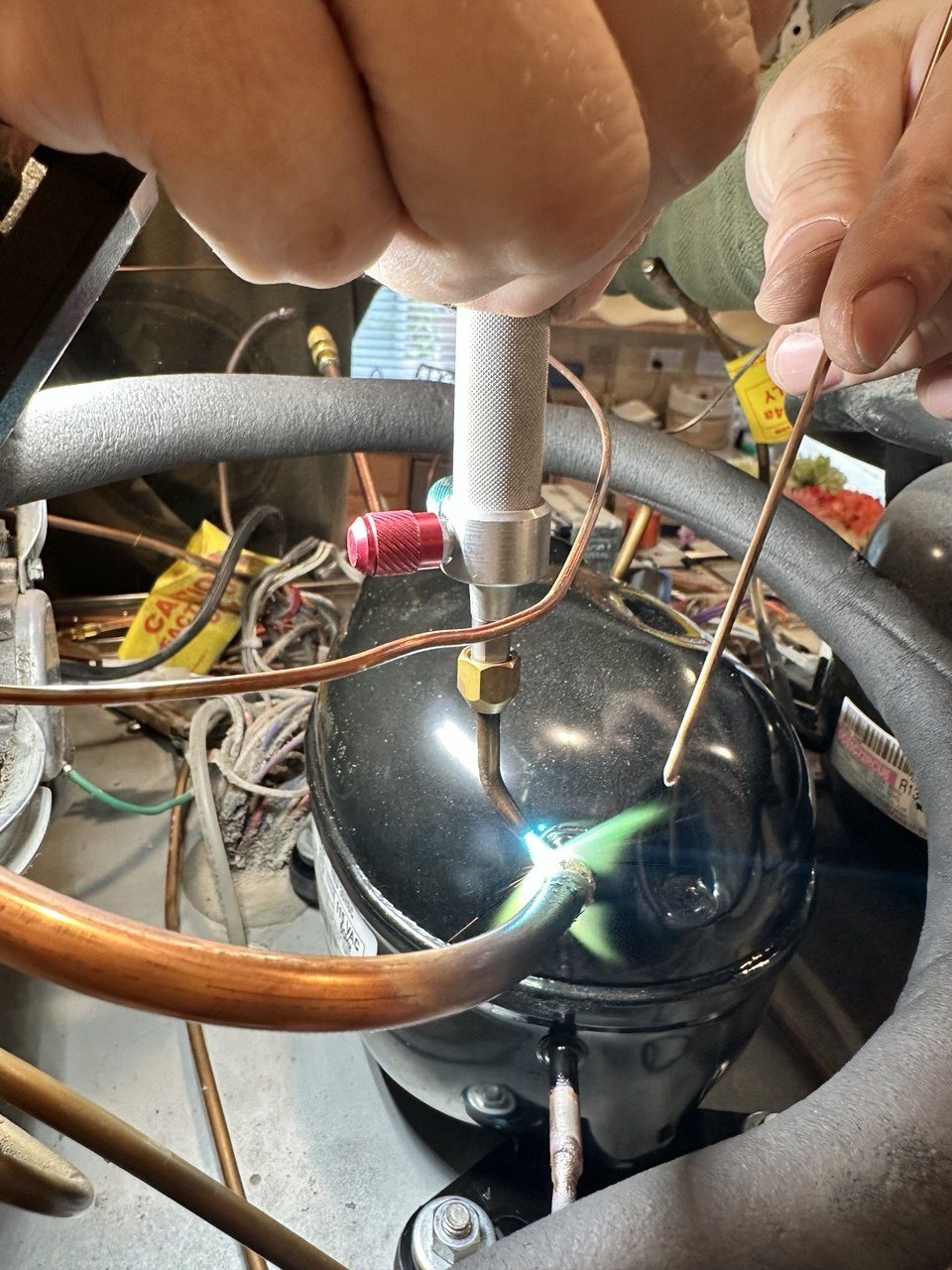
Sealed-system leaks. One side slowly losing temperature while that compressor runs long is the classic sign. Diagnosis means reading suction pressure, measuring line temperature, and finding the leak before any refrigerant goes in. Refrigerant work requires EPA certification and recovery equipment. A sealed-system repair done wrong is a callback that costs more than the first job. We usually stock gauges, a micron meter, and recovery because this work requires them.
Defrost faults. A failed heater, terminator, or sensor lets the evaporator ice up until airflow drops and the compartment warms. Getting to the evaporator means disassembly. We do resistance and continuity checks first to identify the bad component before pulling anything apart, so we are not guessing at parts.
Door and hinge complaints. On integrated and column-style doors the hinge cartridge wears, the heavy panel sags, and the magnetic seal fails. Setting a heavy custom door back to a clean seal requires alignment tools and knowing the adjustment specs for that specific model. Done wrong, the seal gaps and the door pulls finish wear unevenly.
Warranty, and why repair wins
Sub-Zero backs the 600 Series with a 2-year full warranty (parts and labor), a 5-year sealed-system warranty (parts and labor), and parts-only sealed-system coverage through year 12. That long sealed-system coverage reflects what Sub-Zero already knows: these are built to be repaired and to run for decades.
The math is simple. A built-in is fitted to your cabinetry, and replacing it runs into five figures plus a refit. Even a sealed-system rebuild, the expensive outlier on repair cost, reads as cheap against a new unit. We give you a repair-or-replace number in writing before any work starts.
For the broader brand picture see our Sub-Zero repair page and our guide on a Sub-Zero that stops cooling. Sealed-system work falls under our refrigeration repair service.
Call us
Warm food is already costing you in spoilage, and a compressor running nonstop shortens its own life. Do not wait it out.
ADRIUM Service Solutions covers San Ramon, Danville, Alamo, Blackhawk, Dublin, Pleasanton, Lafayette, Orinda, and the rest of the Bay Area. Licensed CSLB #1136642, EPA #1279674151528, BEAR #50788, A+ with the BBB. The $99 diagnostic credits toward the repair. Written estimate before any work starts. We’ll get you on the schedule fast, often same or next day when we can.
Call (925) 999-4095 or email welcome@adriumservice.com, or book online.
What Sealed-System Work Looks Like