
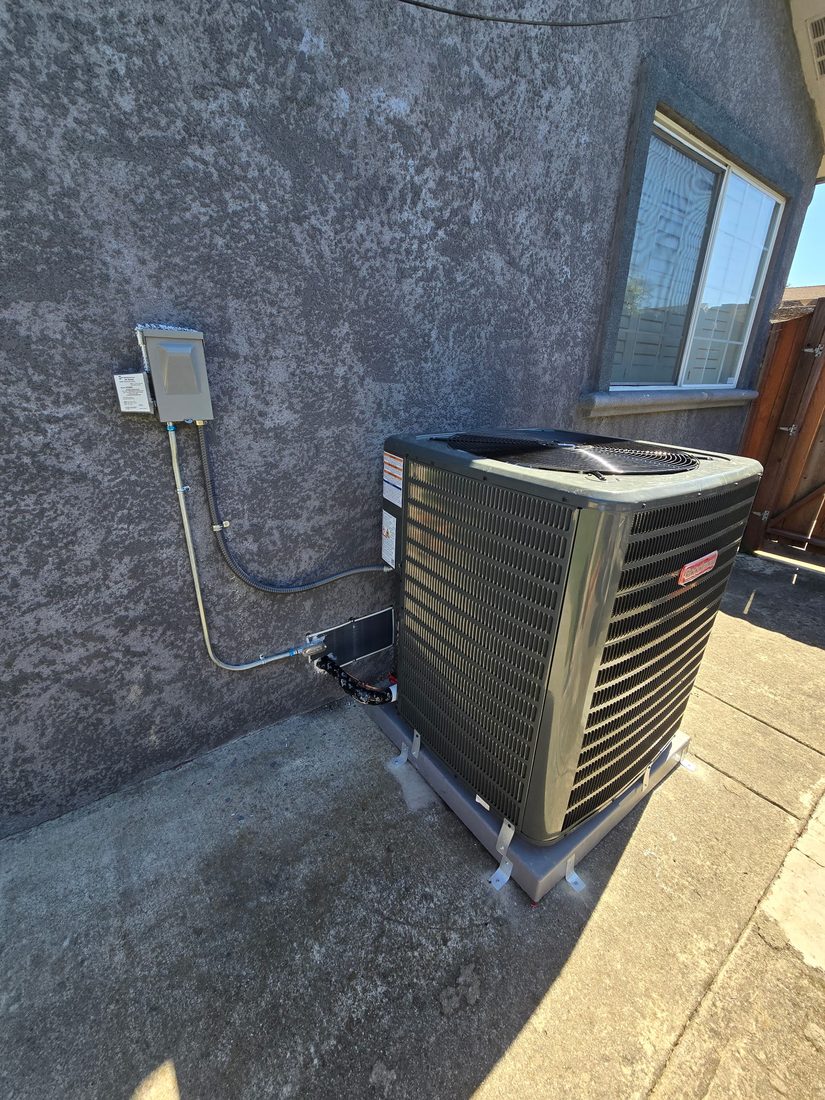
When someone calls ADRIUM about going to a heat pump, I start with one question before anything else. Do you have ductwork, and is it any good? That decides ducted versus ductless faster than budget, brand, or efficiency numbers ever will. Everything else is detail.
Ducted and ductless are the same machine with a different mouth
People treat heat pump and mini-split as two products. They aren’t. A mini-split is a heat pump. A ducted system is a heat pump. Both run the same vapor-compression refrigerant cycle, both have an outdoor condenser, both move heat instead of burning gas. The only real split is how the conditioned air leaves the coil and reaches your rooms.
A ducted system uses one indoor air handler, usually sitting in an attic, a closet, or the garage. Refrigerant lines tie it to the outdoor unit, and then your existing supply ducts carry the air to every register. One indoor box, one thermostat, whole house.
A ductless system skips the ducts. The outdoor condenser feeds refrigerant straight to wall or ceiling heads, one per zone, each with its own control. No air handler, no duct losses, no shared thermostat unless you tie them to one app.
On paper the efficiency is close. Both sides run roughly 15 to 22 SEER2 in current variable-speed equipment. So this is not an efficiency contest. It is a question of what your house already has in the walls.
Ducts in decent shape usually mean ducted
If your home already has ductwork that passes a duct-leakage test under about 15 percent, with no crushed runs and R-6 or better insulation on attic sections, ducted is almost always the cheaper and cleaner path. You already paid for the distribution system. We swap the furnace and condenser for a heat pump and air handler, balance the airflow, and you’re done.
Most tract homes I see in San Ramon, Dublin, Pleasanton, and Concord built from the mid-1980s onward fall into this group. The ducts are sealed enough, the layout is straightforward, and one thermostat keeps the family happy. If nobody in the house is fighting over bedroom temperatures, paying per-zone for ductless makes no sense here.
No ducts, or dead ducts, means ductless
Ductless takes over when ducts are missing or finished. Pre-1950 housing all over the Bay Area, the Berkeley Craftsmans, Oakland bungalows, Alameda Victorians, older Lafayette and Orinda mid-centuries, often never had central ducting at all. Cutting new duct chases into plaster walls and finished ceilings is weeks of demolition and often costs as much as the equipment. A mini-split avoids that entirely. Line sets are about three inches of wall penetration per head.
Ducts that exist but are finished off get you to the same place. Thirty-year-old runs with collapsed sections, asbestos wrap that needs abatement, or leakage above 25 percent that sealing cannot fix. Repairing or replacing that ductwork can add four to ten thousand dollars to a ducted job. When ducts are that far gone, ductless sometimes comes in cheaper overall, not just more comfortable.
Zoning is the other reason people land on ductless. If you want the bedrooms cool at night while the front of the house stays warm in the morning, or a home office held at one setting and the rest of the house at another, each ductless head is independent. That’s comfort you can’t get from a single ducted thermostat.
Sizing comes from a load calculation, not a room count
The most common ductless mistake I correct is oversizing. People count rooms and slap a head on each one. On multi-zone work I size off a Manual J load calculation per zone.
Real numbers I use as a starting point. An open-plan main floor often runs on one larger head at 24,000 to 36,000 BTU. Bedrooms usually want 9,000 to 12,000 BTU each, and a 12,000 head in a small bedroom will short-cycle and leave you clammy. A typical three-bedroom whole-home ductless layout lands at three to five heads. For Tri-Valley design conditions I plan around a 99 percent winter design temp near the low 30s and a summer design near 100 in the inland valleys, which keeps the heat pump in its efficient range instead of oversized and cycling.
The hybrid cases are where the money decision lives
Two situations need real analysis instead of a quick rule.
Start with partial ductwork. Plenty of two-story homes have ducts to the main floor while the upstairs bedrooms run on old wall heaters. I will sometimes spec a ducted heat pump downstairs plus two or three ductless heads upstairs. It’s the best comfort outcome and it skips tearing open a finished second floor, but it costs more to design and commission.
The other one is a remodel on the horizon. If a kitchen or bath remodel is coming in the next year or two, those open walls give cheap access to fix or reroute ducts. In that case I often recommend ducted now with duct sealing folded into the remodel rather than paying for duct work twice. Timing changes the right answer, so we talk through your plans at the estimate.
What it actually costs, and what the rebates do
Practitioner ranges, installed, before any incentive. Single-zone ductless runs about 5,500 to 9,000 dollars. A three-zone ductless system runs roughly 12,000 to 16,000. A whole-home ducted heat pump runs about 14,000 to 18,000. Per zone, ductless costs more up front. The math flips when ducts are failing or absent, because then ducted is either far more expensive or not really an option.
On incentives, be careful what you read online. The federal 25C heat pump tax credit expired December 31, 2025 under the new federal law, so do not budget around it. Tech Clean California is closed or waitlisted, not an active rebate right now. State and utility programs like BayREN, MCE, and PG&E offerings shift constantly and depend on equipment efficiency and contractor registration. I do not quote a dollar figure off memory. We confirm exactly what is paying, to whom, on your equipment, when we write the estimate. We are EPA 608 certified, Daikin factory-trained, hold CSLB #1136642, and the $99 diagnostic is credited toward the repair.
Where this work lives
For brand choice, Daikin (factory-trained) and Mitsubishi (factory-course trained) are my first picks for parts availability and field reliability, with LG, Cooper and Hunter, and Gree as workable second-tier. On ducted, Carrier, Daikin, Goodman, Trane, Lennox, and Mitsubishi all build solid variable-speed units, and I match the brand to the home rather than push one label.
ADRIUM handles both appliance and HVAC work, but the deep HVAC focus, the load calculations and full system design, lives in our dedicated division, Bay Area HVAC Service. If you want a written quote that runs both options side by side, that is where the heat pump design work gets done.