
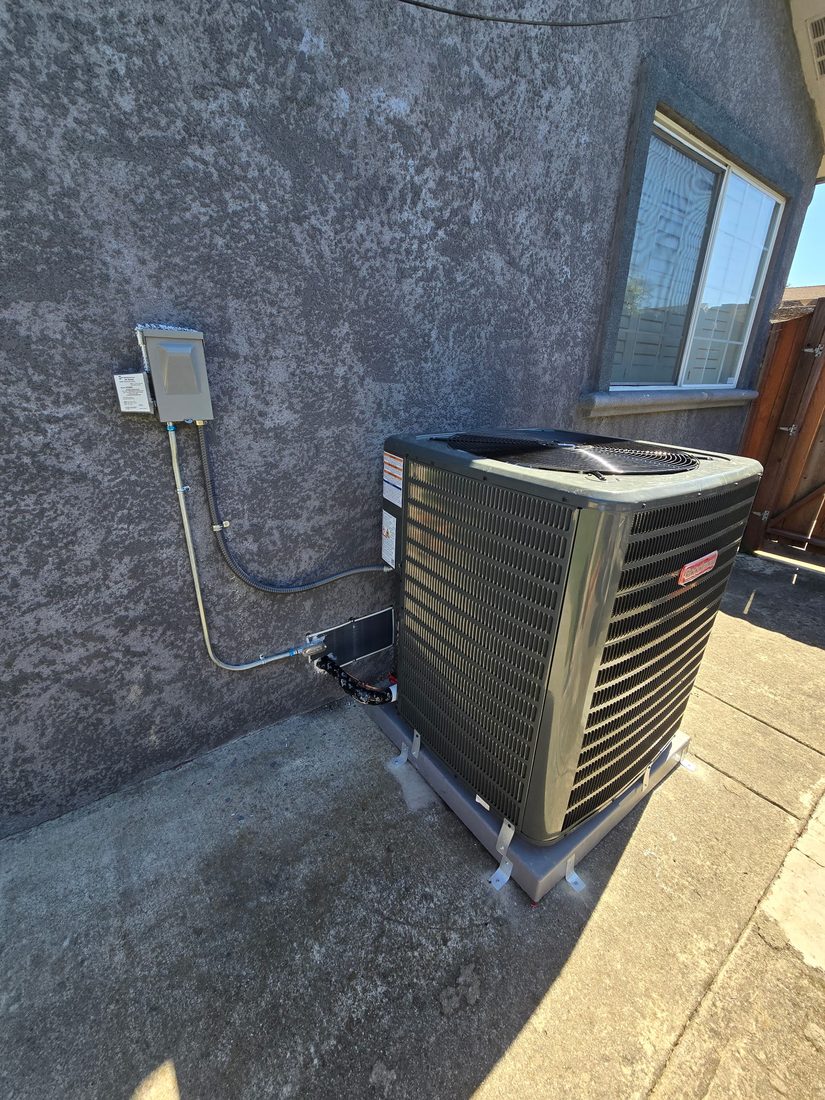
A gas furnace and a heat pump heat your house two different ways
A gas furnace makes heat. It burns natural gas inside a metal heat exchanger, and a blower pushes house air across that hot metal. A heat pump does not make heat at all. It moves heat. In winter it pulls warmth out of the outdoor air, even cold air, and carries it inside through refrigerant. In summer it runs the same cycle backward and acts as your air conditioner. One box, both seasons.
That single difference drives everything else. A furnace burns fuel and turns most of it into heat, but you never get more energy out than the gas carried in. A heat pump works around that limit, because it relocates heat instead of creating it. A decent inverter heat pump delivers roughly 2 to 4 units of heat for every unit of electricity it draws, versus a maximum of 0.97 or so for even the most efficient gas furnace. On a Tri-Valley winter morning, that ratio is real money on the PG&E bill.
Our winters are exactly where heat pumps are strongest
The old objection to heat pumps was cold weather. That argument does not hold here. Inland cities like San Ramon, Danville, and Pleasanton design out to about 32 to 35 degrees F. We see frost on a windshield, not a Midwest deep freeze. Coastal areas stay milder still.
Modern variable-speed units hold their rated capacity far below our worst night. Daikin Aurora, Mitsubishi Hyper-Heat, and similar cold-climate models put out full capacity down near 0 degrees F and keep running below that. So in the Bay Area, the heat pump spends nearly the whole season inside its efficient operating band. You are not paying a winter penalty. You are collecting the full benefit.
A ducted swap versus ductless depends on what is already in the walls
If your house already has ductwork and a working air handler closet, a ducted heat pump is close to a direct replacement for the furnace and AC. Same registers, same returns, new equipment.
If you have no ducts, wall heaters, or a floor furnace, I usually steer people toward a ductless mini-split instead of tearing open the house to run new duct. Mini-splits put an air handler in each zone and connect back to one outdoor unit through a small refrigerant line. Cleaner install, better room-by-room control, less demolition. Older homes sometimes need a sub-panel because the electrical service is tight. We assess the panel during the estimate, and if an upgrade is needed, a licensed electrician handles it as part of the project so there are no surprises mid-job.
Sizing is where most heat pump installs go wrong
The most common installer mistake I see is oversizing. Bigger is not safer. An oversized heat pump reaches temperature too fast, shuts off, then restarts a few minutes later. That short-cycling wears the compressor, leaves humidity in the air, and runs noisy.
The fix is a Manual J load calculation. It accounts for square footage, insulation, window area and orientation, and our local design temperatures instead of a guess off a rule of thumb. If a contractor quotes you a tonnage without measuring the house, that is a red flag. Ask directly whether they perform Manual J. I would walk away from anyone who cannot answer that. As a DOE Home Energy Score and BayREN-aligned shop, we run the load math before we spec equipment.
The rebate picture in 2026 is smaller than it was
Be careful with old advice here, because the incentive landscape changed. The federal 25C heat pump tax credit expired December 31, 2025 under the new federal law. It is gone. Treat any 2024-era article promising a federal credit as out of date. Tech Clean California is closed and on waitlist, not paying.
What can still apply depends on your utility and territory: BayREN heat pump cycles when funding is open, MCE Heat Pump HVAC for MCE customers, PG&E thermostat and seasonal ENERGY STAR rebates, EBCE/Ava in parts of Alameda County, and manufacturer instant rebates that come straight off equipment cost during a promo. Eligibility and dollar amounts move around by program and by month, so I will not quote you a number off a blog. We confirm what is actually paying when we write the estimate after checking contractor participation and application timing.
Real Bay Area install ranges
For planning, here is what these jobs actually run before any rebate. A single-zone ductless mini-split lands around $5,500 to $9,000. A whole-home 4-ton ducted heat pump runs roughly $14,000 to $15,500. Out-of-pocket drops from there depending on which programs are open in your territory the week we install. Those are practitioner numbers, not a sticker, and the written quote is the version that counts.
| Gas furnace | Heat pump | |
|---|---|---|
| Heats by | Burning gas | Moving heat with electricity |
| Cooling | Needs a separate AC | Built in, one system |
| Bay Area winter fit | Fine | Strongest here, the mild climate suits it |
| Typical install before rebates | $4,500 to $8,000 (furnace only) | $14,000 to $15,500 ducted; $5,500 to $9,000 single-zone ductless |
| Best when | Furnace under ~10 years, weak electrical or propane | Furnace 15+ years, you also want cooling, electrification |
When I tell a customer to keep the gas furnace
I do not push heat pumps onto every job. If your furnace is under about ten years old and running clean, replacing it early rarely pays. If you are on propane in a spot with weak electrical service, the upgrade cost can swamp the savings. And if there is genuinely no practical refrigerant line path, which is rare in single-family homes, that changes the math too. I walk through those cases at the estimate rather than sell a conversion that does not fit.
If your furnace is 15-plus years old, or it holds a phased-out refrigerant on the AC side, replacement is the right call and the heat pump is usually the better box.
How ADRIUM handles the work
We are EPA 608 certified and licensed under CSLB #1136642, Daikin factory-trained, with Mitsubishi factory coursework behind us. The $99 diagnostic is credited toward the repair, every quote is written, and heat pump installs carry a 10-year parts warranty; labor is 2 years standard, extended to 10 years with our maintenance plan, subject to your contract terms.
Heat pumps and full system design are the deep specialty of our HVAC division, Bay Area HVAC Service. If you want the design-level conversation about load math, zoning, and equipment selection, that is the team that lives and breathes it. ADRIUM covers the same Bay Area footprint, and either way you get the same crew standards behind the work.