
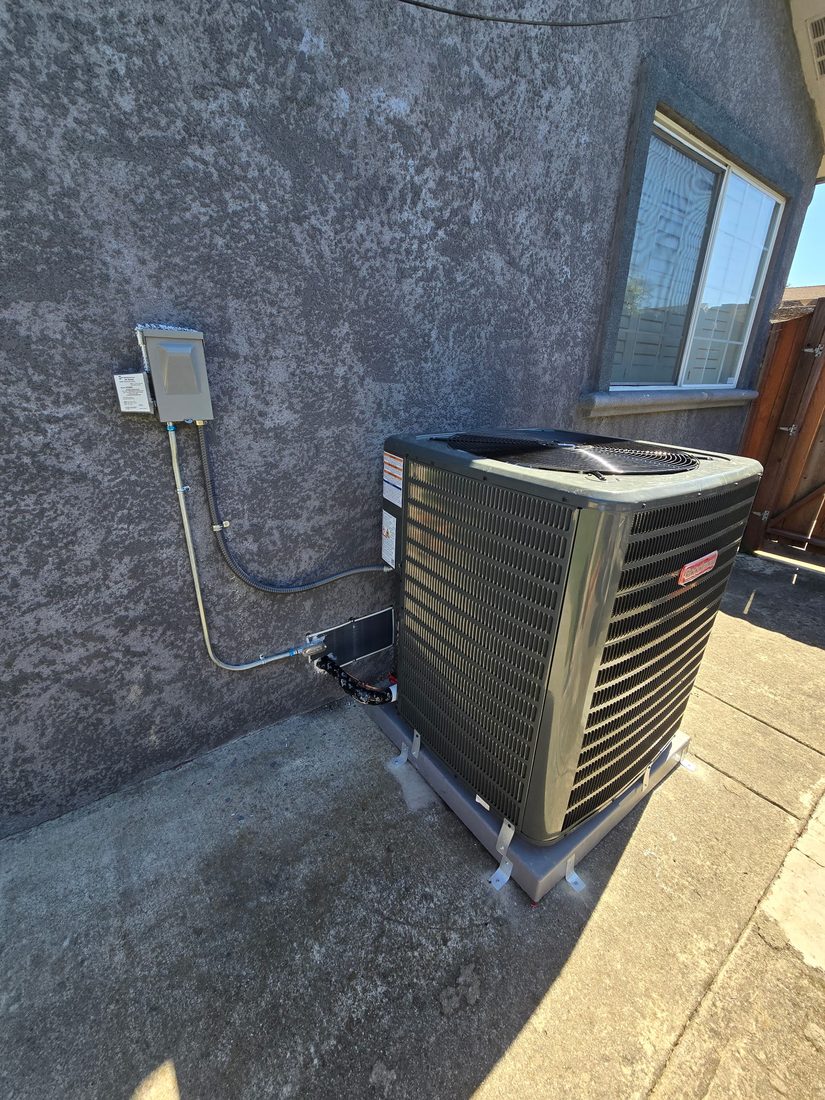
Sizing is the one decision you cannot undo later
When a heat pump install disappoints a Tri-Valley homeowner, the cause is rarely the brand on the box or the way the installer landed the wires. It is the tonnage printed on the proposal. Get that number wrong and no thermostat setting, no tune-up, no clever control strategy buys it back. You live with the choice for the full fifteen years until the equipment wears out.
The mistake I see most on second-opinion calls is too much capacity. A homeowner reads that heat pumps fade in cold weather, decides bigger must be safer, and signs for a half-ton or a full ton more than the house needs. What they get is a system that runs loud, cycles in short bursts, leaves the air damp, and never returns the bill savings the sales sheet promised. Below I walk through how I actually choose tonnage for a Bay Area house, with the numbers behind each step.
Cooling load governs the size here, not heating
A straight air conditioner answers one question. How much heat do I pull out of the house on the hottest afternoon. A heat pump answers two, since it cools in summer and heats in winter. Across most of the country those two loads pull against each other. In the upper Midwest the winter number wins. In the desert the summer number wins.
The Bay Area is the easy case. Our summer load is the large number and our winter load is the small one. Design cooling runs from roughly 81F on the East Bay coast to 99F inland in San Ramon, Danville, and Pleasanton. Design heating only falls to about 30F inland and 36F near the water. In delivered BTU per hour the gap is wide, so cooling sets the governing load on nearly every job.
So I run the cooling calculation first. When the heating load lands lower, which it almost always does, the cooling number is my answer. The exceptions are leaky older two-stories with unusually high heat loss sitting in the coldest inland pockets. Those are uncommon.
The cold-weather worry is built on old equipment
The claim that heat pumps quit in the cold matches 1990s hardware. It does not match what I bolt down today. Cold-climate inverter units hold their rated heating output well past anything our winters throw at them.
- Daikin Aurora holds full rated capacity down to about 5F.
- Mitsubishi Hyper-Heat holds full rated capacity to about 5F and keeps producing below zero.
- Cooper and Hunter, plus most other cold-climate inverter lines on the market today, hold full rated output to roughly 5F. Confirm the spec sheet for your specific model.
Our coldest inland design point is 30F. Every one of those units sits comfortably inside its rated band at 30F. That is why I install the large majority of Bay Area heat pumps with no electric backup strips at all. Backup heat solves a northern problem we mostly do not have.
Balance point, worked through with real numbers
Balance point is the outdoor temperature where the heat pump’s real output matches what the house is losing. Above it, the heat pump carries the house on its own. Below it, something has to help.
Take a typical inland home losing 30,000 BTU per hour at the 30F design point, paired with a 3-ton cold-climate unit rated 36,000 BTU per hour at 47F.
- At 47F the unit makes 36,000 BTU/h. The house wants maybe 15,000. Wide margin.
- At 30F, the design low, a modern inverter still delivers around 32,000 BTU/h against a 30,000 need. Balanced. No backup called.
- At 15F, which CZ12 sees a handful of hours per decade, output drops toward 25,000 against a higher demand. Backup would help for those few hours, if you bother to add it.
On the coast and across the South Bay the math gets even softer. When a quote insists you need heat strips, it usually means someone lifted a spec sheet from a colder market.
Oversizing wastes the efficiency you paid for
An inverter heat pump earns its money by modulating. It slides between roughly 30 percent and 100 percent of capacity, running slow and quiet to track a partial load instead of slamming on and off. That behavior only shows up when the unit fits the house.
Drop a matched 3-ton unit into a 3-ton house and it spends most hours at 30 to 50 percent, climbs to 60 to 80 on a normal summer afternoon, and reaches full output only on the design day. Drop a 4-ton unit into that same house and its minimum 30 percent already equals about 1.2 tons, more than the home wants most of the year. It short-cycles against its own floor. You paid for variable-speed hardware and receive none of the quiet, the comfort, or the moisture removal it should hand you. Bigger is worse here, not safer.
Starting tonnage by area
These are rough starting points only. The real number comes out of a Manual J with your envelope, windows, and ductwork actually measured.
- Inland Tri-Valley and Diablo Valley: 2 to 3 tons for 1,200 to 1,800 sqft, 3 to 4 tons for 1,800 to 2,500, 3.5 to 5 tons for larger two-stories that often want zoning.
- South Bay: figure about half a ton lighter than inland for the same square footage.
- East Bay coast: lighter again, and often a better fit for ductless heads per zone than one ducted system.
If the home has sound existing ducts, a ducted swap is usually the clean answer. With no ducts, a ductless mini-split per zone almost always wins. Some homes call for both.
How we handle the numbers and the money
On an ADRIUM heat pump quote the sizing comes before the equipment, never after. We measure the envelope, count and orient the windows, check the duct condition, and run the Manual J. The tonnage that falls out decides which models we put in front of you. Our diagnostic is $99 and credited toward the repair, every quote is written, and a full install carries a 10-year parts warranty; labor is 2 years standard, extended to 10 years with our maintenance plan, subject to your contract terms. I hold EPA 608 certification, the company carries CSLB #1136642, and I have finished Daikin and Mitsubishi factory training.
A typical 4-ton inverter install in the inland zone runs roughly $14,000 to $15,500 depending on duct and electrical work. On incentives, be careful what you read online. The federal 25C heat-pump tax credit expired December 31, 2025 under the new federal law, so treat any page claiming it is still live as out of date. The statewide Tech Clean California program is closed or waitlisted in our area and not paying out. BayREN and similar local programs shift constantly, so I will not print dollar figures here. We confirm exactly what is actually paying at the time of your estimate.
Sizing and full system design is the daily work of our dedicated HVAC division, Bay Area HVAC Service, where the load calculators and the deeper heat-pump engineering live. For a number tied to your specific house, call ADRIUM at (925) 999-4095 and we will schedule an on-site Manual J.