
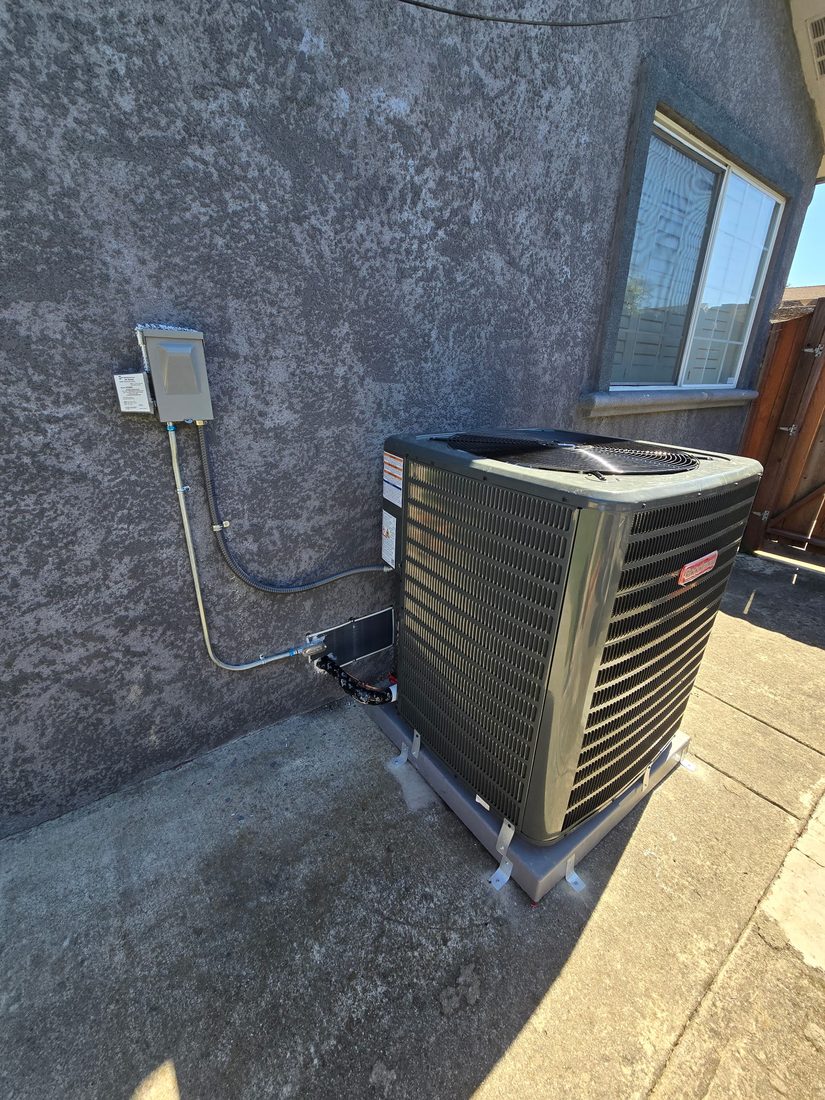
When a homeowner in Pleasanton or Walnut Creek calls us about a heat pump, the first question is always price. I cannot give a real number over the phone, and any contractor who does is guessing. What I can do is explain what moves the cost, what stays fixed, and where the surprises hide. Almost all of the variation comes from three things: how big the system needs to be, what shape the existing ductwork is in, and whether the electrical panel can carry the load.
Two install types live in two different price worlds
A whole-home ducted heat pump for a typical 1,800 to 2,500 square foot Bay Area house runs roughly $14,000 to $18,000 before any rebates, sized at 3 to 4 tons. That covers the outdoor unit, the indoor air handler, the line set, permits, and commissioning.
Ductless mini-splits price out very differently because there are no ducts to deal with. A single-zone system to handle one room or an addition lands around $5,500 to $9,000 installed. Step up to three indoor heads and you are usually in the $12,000 to $16,000 band. Four or more zones I quote per project, because routing, wall penetrations, and condensate handling start to vary a lot from house to house.
| System or add-on | Typical Bay Area 2026 cost (before rebates) | Best for |
|---|---|---|
| Ducted whole-home heat pump, 3 to 4 ton | $14,000 to $18,000 | Homes with usable ductwork |
| Single-zone ductless mini-split | $5,500 to $9,000 | One room, addition, or ADU |
| Three-zone ductless | $12,000 to $16,000 | Whole home with no ducts |
| Duct replacement (add-on) | $2,500 to $6,000 | Ducts past 25 years or over 25% leakage |
| Duct sealing or Aeroseal (add-on) | $800 to $2,000 | Salvageable ducts |
| Sub-panel (add-on) | $1,800 to $4,500 | Older panel near capacity |
| 200A service upgrade (add-on) | $3,500 to $7,500 | Existing 100A or 125A main |
These are practitioner numbers for 2026. They sit higher in real terms than two years ago, partly because several incentive programs that used to soften the price have closed.
Sizing is where money gets wasted
A “ton” is 12,000 BTU per hour of capacity. The lazy rule of thumb is one ton per 600 to 800 square feet, and I use that only as a sanity check. The real number comes from a Manual J load calculation that looks at insulation, window area and orientation, ceiling height, and air leakage.
The most expensive mistake I see is oversizing. A 5-ton condenser dropped into an 1,800 square foot home looks generous on paper and runs terribly. It short-cycles, never pulls humidity properly, and the compressor wears out years early. Bay Area design temperatures are mild, around 35 to 40 degrees for winter heating in most of the Tri-Valley, so a correctly sized variable-speed unit spends most of the year loafing in its efficient range. That mild climate is exactly why heat pumps make sense here, but only if the equipment matches the actual load instead of the salesman’s comfort margin.
Ductwork condition can add nothing or add thousands
If your existing ducts pass a leakage test, hold under about 15 percent leakage, have no collapsed runs, and carry R-6 or better insulation in the attic, I keep them. That keeps you at the base price.
Old ducts are a different story. Once you are past 25 years, with leakage above 25 percent or crushed sections, replacement adds roughly $2,500 to $6,000 depending on access and home size. There is a middle path. Sealing accessible runs by hand with mastic, or an Aeroseal injection, can recover real conditioned air for $800 to $2,000 without a full tearout. Our technician walks the attic and crawlspace before quoting any of this, because guessing from the thermostat is how estimates blow up mid-job.
The electrical panel is the hidden line item
Heat pumps want 240V circuits, and a good share of older Bay Area homes built in the 1950s through 1970s cannot spare the capacity. A sub-panel to feed the new equipment typically runs $1,800 to $4,500. If the main service is still 100A or 125A and needs to go to 200A, that is a bigger job, usually $3,500 to $7,500.
I run a capacity check at the estimate and put any panel work on the written quote before we start, coordinated with a licensed electrician under the same project. Nobody likes finding out about a panel upgrade after the old furnace is already in the driveway.
What the install price actually covers
For a standard ducted job, the quote includes the Manual J calculation, equipment selection, the condenser and air handler, the refrigerant line set and charge, pressure testing, removal and disposal of the old gear, the permit and inspection coordination, in-scope electrical, commissioning, and a performance baseline so we know the system is running to spec. ADRIUM backs installs with a 10-year parts warranty plus a labor warranty (2 years standard, extended to 10 years with our maintenance plan), subject to your contract terms.
What is not baked in by default: duct replacement, sub-panel or service upgrades, and any structural work to seat the equipment. Those show up as their own lines so you can see exactly what each one costs.
Rebates change, so I confirm them live
I work with BayREN, MCE, PG&E, and EBCE/Ava programs, plus seasonal manufacturer instant rebates that come off the equipment at the distributor. Eligibility, funding, and dollar figures shift by territory and program cycle, so I will not print a number here. We confirm what is actually paying at the time we write your estimate.
Two things to be clear about, because people still ask. The federal 25C heat pump tax credit expired December 31, 2025 and is gone, so do not budget around it. Tech Clean California is on waitlist and not taking new projects. Planning a conversion around either one coming back is a gamble with no published reopen date.
Repair versus replace comes down to the math on site
If your system is past 15 years and facing a compressor or heat exchanger failure, replacement usually wins on lifetime cost. Under 12 years with a repair below $1,500, I fix it. The grey zone in between is where we run your PG&E numbers on site and let the math decide.
Heat pump design and whole-home electrification is the core focus of our dedicated division, Bay Area HVAC Service (bayareahvacservice.com), if you want to go deeper on load calculations, equipment selection, and duct design. Either way, ADRIUM puts the real numbers on a written quote, and the $99 diagnostic is credited toward the repair.