
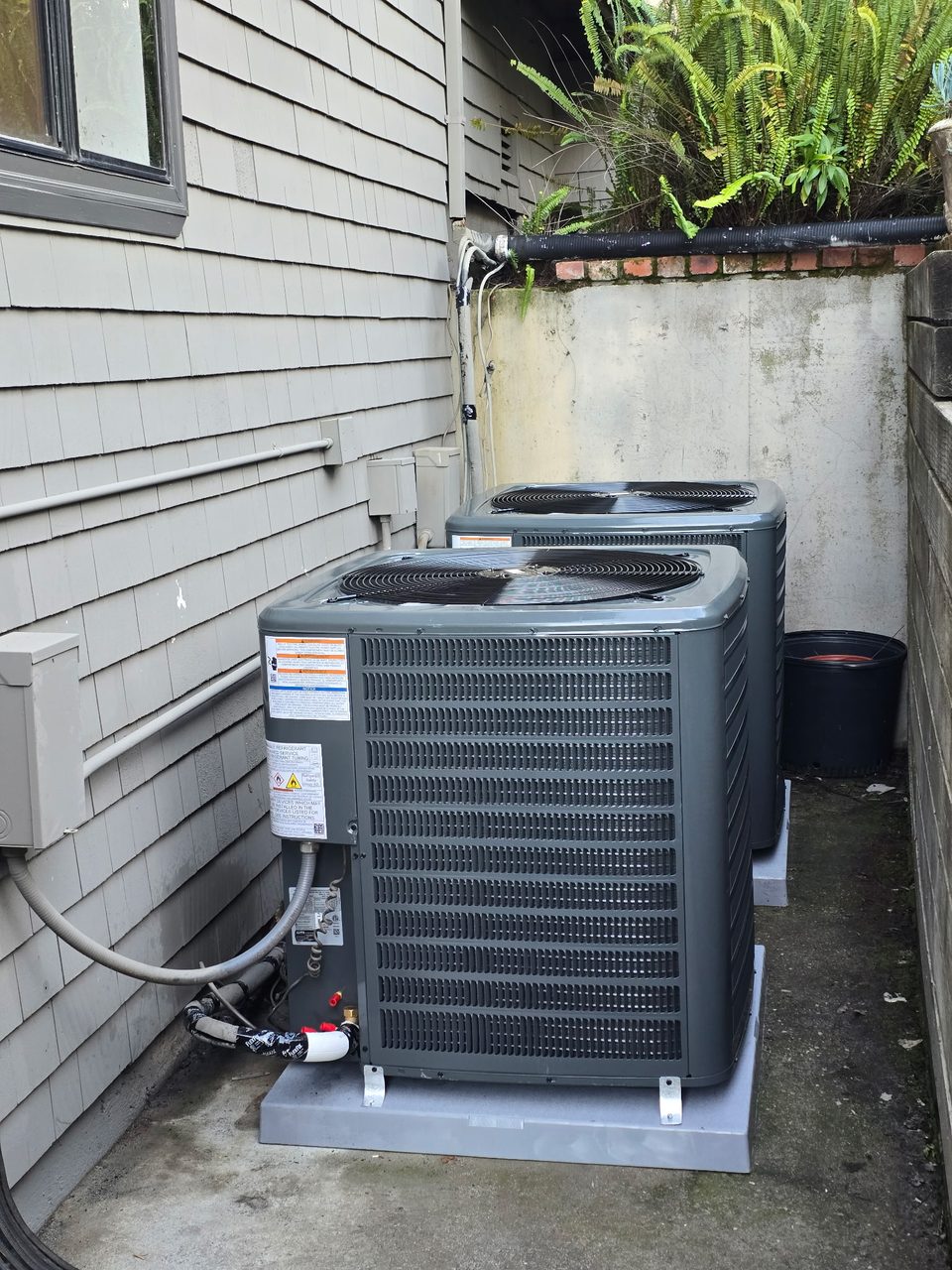
When an air conditioner ices over, people usually think it is low on something. Most of the time it is the opposite problem. The coil is starving for air, not refrigerant. I want to walk through what actually happens inside the system when it freezes, and the order I check things on a real call. This is appliance and HVAC territory, but freezing is one place where the physics matters more than the brand on the cabinet.
A frozen coil is a heat-balance failure
The indoor evaporator coil is a heat exchanger. Warm room air blows across cold fins, the refrigerant inside boils, and the air gives up its heat. The coil normally runs around 40 to 45 degrees Fahrenheit. That is above freezing on purpose. Moisture in the air condenses on it and drips into the drain pan, which is why a healthy AC dehumidifies.
Ice forms when that balance breaks. If too little heat reaches the coil, the refrigerant cannot absorb enough energy to stay at its design temperature. The coil temperature falls below 32 degrees. Condensation that should drip away freezes in place instead. Once a thin layer of frost forms, it insulates the coil, less air gets through, and the freeze accelerates on itself. A light frost at 9 AM becomes a solid block by noon.
So the real question is never just whether it is iced. It is what cut the heat load on the coil. That points you at two families of cause: not enough air moving across it, or not enough refrigerant pressure inside it.
Turn cooling off and the fan on before anything else
If you see ice on the indoor coil or frost on the copper line at the outdoor unit, stop cooling now. Set the thermostat to OFF for cooling and set the fan to ON, not AUTO. The blower keeps pushing room-temperature air across the coil and melts the ice safely.
The reason this matters is the compressor. When the coil is frozen, refrigerant does not fully boil into vapor inside it. Liquid refrigerant slugs back down the suction line to the compressor, which is built to pump vapor, not liquid. That is called flooding, and it wears bearings and valves fast. A compressor is the single most expensive part on the system. A clogged filter is an inexpensive fix. Running the system frozen can turn that small problem into an expensive one.
Expect one to four hours for a full thaw depending on how much ice built up. Put a towel down. A badly frozen coil can shed a couple of gallons of water.
Airflow problems cause most freezes
In the field, restricted airflow is the first thing I find more often than not. The checklist runs from cheapest to most involved.
The filter is first. A filter packed gray with dust chokes the return. If you cannot see light through it, replace it. I have cleared plenty of freeze calls with nothing but a fresh filter. After that, look at the registers. Homeowners close vents in spare rooms to save energy, but close too many and you starve the return path. Open them back up.
Then come the things you cannot see from the hallway. Flex duct in the attic kinks where it crosses framing, and a collapsed run kills airflow to part of the house. The evaporator coil itself loads up with dust and biological film over the years, and even a half millimeter of buildup measurably drops airflow and heat transfer. Last is the blower. A motor on its way out, or a weak run capacitor, spins slower than rated and moves less air. Put your hand on a supply register. If the push feels weaker than last summer, the blower is suspect.
Low refrigerant means a leak, not a refill
The second family is low refrigerant. Lower pressure inside the coil lowers the temperature at which the refrigerant boils, and that pulls coil temperature below freezing even with the air moving fine.
Refrigerant is not a consumable. It does not burn off or get used up. If the charge is low, the system is leaking, full stop. I hook up gauges, read suction and liquid pressures, and calculate superheat and subcooling to confirm it before touching anything. Common leak points are coil seams, line-set flare fittings, the brazing at the condenser, and Schrader valve cores. Topping off without finding the leak just buys you a few months and another freeze.
Repair cost tracks the refrigerant type. R-410A repair and recharge cost depends on where the leak sits. R-454B, the current standard on new installs, runs similar. R-22 is phased out, the gas alone is expensive when you can get it, and a leaking R-22 system is usually a replacement conversation rather than a repair.
Cool Bay Area nights freeze coils too
Here is one specific to our climate. In April, May, October, and November, the Tri-Valley runs AC on evenings in the 55 to 65 degree range. A standard air conditioner is not designed to run when it is that cool outside. Low outdoor temperature drops head pressure, the coil saturation temperature follows it down past freezing, and the coil ices up on a perfectly charged system.
If your AC only freezes on mild evenings and runs clean on hot afternoons, this is almost certainly the cause. The fix is a thermostat with a low-temperature lockout, or simply not running cooling below about 65 degrees outdoors. Properly controlled heat pumps do not have this problem because they manage shoulder-season operation differently.
What we do and what it costs
On a freeze call I confirm the coil is thawing, inspect the filter, registers, and accessible duct, check the indoor coil for buildup, connect gauges to read pressures and figure superheat and subcooling, then test blower amperage and capacitor against spec. Plenty of calls have two causes at once. A dirty filter and a slow leak together is common. You get a written quote before any work. Our diagnostic is $99, credited toward the repair.
A few cases push toward replacement instead of repair. A leaking R-22 system. A unit past 15 years on its third or fourth significant repair. A cracked coil where the replacement coil approaches half the cost of a new system. I run the actual numbers at the estimate. I do not sell a new system when a repair is the right call, and I do not put a temporary bandage on something that will fail again next summer. If a rebate or utility program applies, we confirm what is actually paying at the time of your estimate rather than quoting a number that may have changed.
We carry CSLB #1136642 and EPA 608 certification, and we back installs with a 10-year parts warranty plus a labor warranty (2 years standard, extended to 10 years with our maintenance plan), and repairs for one year.
If your AC iced over and a fresh filter did not fix it, call us. We serve the Bay Area and will get you on the schedule fast, often same or next day when we can. Schedule at adriumservice.com. When a freeze turns into a bigger design question, like resizing or switching to a heat pump, that load-calculation work is handled by our dedicated HVAC division, Bay Area HVAC Service (https://bayareahvacservice.com).