
I Start With the Failed Part, Not the Birth Year
Most repair-or-replace guides open with equipment age and a dollar threshold. Both matter, and I use them. But on an actual service call I work the decision the other way around. The part that failed tells me where the system sits in its life and whether the failure is isolated or a symptom of something larger.
A run capacitor that pops on a 9-year-old condenser may need only a capacitor replacement if the rest of the system checks out. A compressor that grounds out on that same condenser is a different story even though the unit is the same age. So before I quote anything, I name the failure mode out loud and explain what it implies about everything around it.
| Failed part | Typical repair cost | Repair or replace |
|---|---|---|
| Flame sensor or hot-surface ignitor | Quoted after diagnosis | Repair, almost always |
| Run capacitor or contactor | Quoted after diagnosis | Repair, almost always |
| Blower / inducer motor or control board, under 12 years | Quoted after diagnosis | Repair |
| Blower / inducer motor or control board, 16+ years | same part cost | Weigh against a replacement quote |
| Cracked heat exchanger | safety failure | Replace (carbon monoxide risk) |
| R-22 sealed-system leak | Current refrigerant cost confirmed in the estimate | Usually replace |
| Compressor failure, 15+ years | high | Replace on lifetime cost |
Cheap Parts That Almost Always Mean Repair
Some failures are routine wear items. Replacing them is rarely a reason to think about a new system:
- Run and start capacitors. Common, inexpensive, and a frequent cause of an AC that hums but will not start.
- Contactors. The relay that pulls in the compressor pits and burns over time.
- Igniters and flame sensors on a furnace. A dirty flame sensor is one of the common no-heat calls I get in January, and cleaning it costs nothing in parts.
- Thermostats and a tripped float switch on the condensate line. Small controls that take down the whole system when they fail.
If the diagnosis lands on one of these and the rest of the equipment checks out, repair is the obvious call regardless of age. I have brought 14-year-old furnaces back to life by replacing a failed sensor.
Mid-Tier Parts Where Age Becomes the Deciding Factor
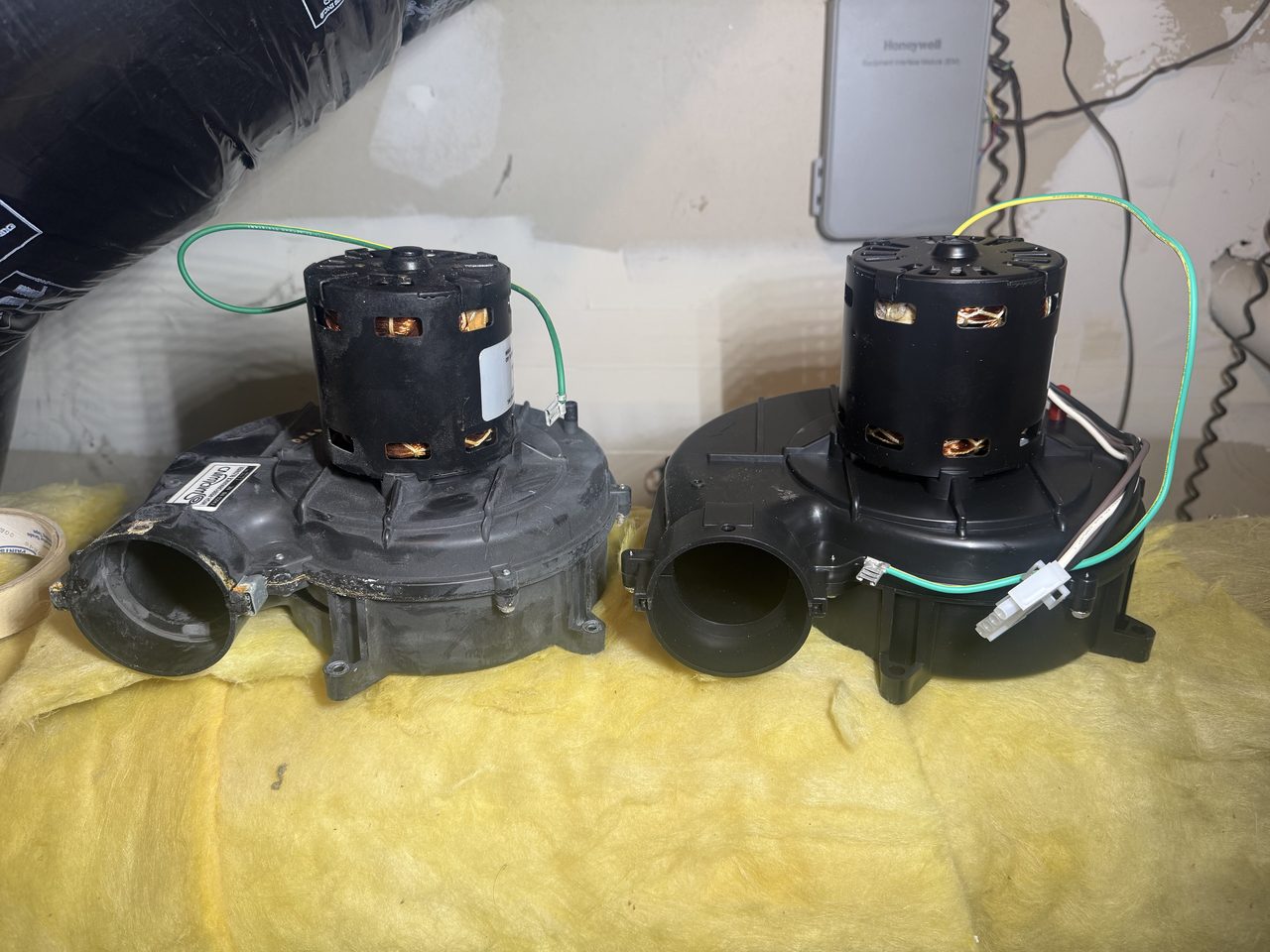
Blower motors, inducer motors, and control boards sit in the middle. Each needs a model-specific replacement and its own labor estimate. The deciding question is what else is aging alongside it.
On a furnace under 12 years old, I replace the part and move on. On a 16-plus year old furnace, I say it straight. This motor may run another two or three winters, but the gas valve, the inducer, and the board are all in the same age bracket. Fixing one expensive part on a system where the next expensive part is close behind is throwing good money after a unit that is winding down. That is the point where I lay out a replacement quote next to the repair so you can compare the two real numbers side by side.
Safety Failures That Override the Math Entirely
A cracked heat exchanger is not a cost decision. It is a carbon monoxide path between the combustion side and the air you breathe. I red-tag those and recommend replacement regardless of what the repair would cost. The fix on a cracked heat exchanger usually means replacing the heat exchanger itself, and on an older furnace that part can run nearly as much as a new unit.
The same logic applies to a confirmed gas valve failure on aged equipment and to a heat exchanger that fails a combustion analysis. When a furnace is putting CO into the supply air, the budget conversation stops.
The Sealed System and the R-22 Trap
The single most expensive thing on a furnace or AC is the sealed refrigerant circuit, and that is where R-22 turns a repair into a replacement decision.
R-22 has not been manufactured in the US since 2020. If your condenser runs R-22 and develops a leak, the repair estimate needs to include the current refrigerant cost and the work to find and seal the leak. The condition of the remaining components matters too, especially on equipment with repeated failures. Once a sealed-system repair is on the table for R-22 gear, replacing with an R-410A or R-454B system is almost always the better few-year math. A leaking evaporator coil or a failing compressor on R-22 pushes the same direction.
Where Incentives Fit, and What Actually Pays
When the replacement option is a heat pump, operating cost and incentives both enter the picture. I will say this plainly so nobody plans around stale numbers. The federal 25C heat pump tax credit expired December 31, 2025 under the OBBBA. It is not available for 2026 installs. Some regional and utility programs still pay and some are on waitlist. I do not quote a rebate figure up front because the funding moves. We confirm what is actually paying for your specific address when we write the estimate.
For real pricing, a clean gas furnace swap in the Tri-Valley usually runs $4,500 to $8,000, and a full heat pump system for a single-family home commonly lands around $14,000 to $18,000 installed before any incentives. Those are ranges. The fixed number comes after I see the equipment and the ducts.
How We Run the Decision With You
Our diagnostic is $99 and it is credited toward the repair. You get a written quote, not a verbal guess. Install work carries a 10-year parts warranty plus a labor warranty (2 years standard, extended to 10 years with our maintenance plan), and repairs carry a one-year warranty, so the decision you make is backed either way. I am EPA 608 certified and the company holds CSLB license 1136642, which means the person handling your refrigerant and your gas connections is accountable for the work.
If you want a deeper dive into HVAC design, load calculations, and heat pump conversions, that is the specialty of our dedicated heating and cooling division, Bay Area HVAC Service. For appliance and HVAC service across San Ramon and the wider Bay Area, ADRIUM is one call.