
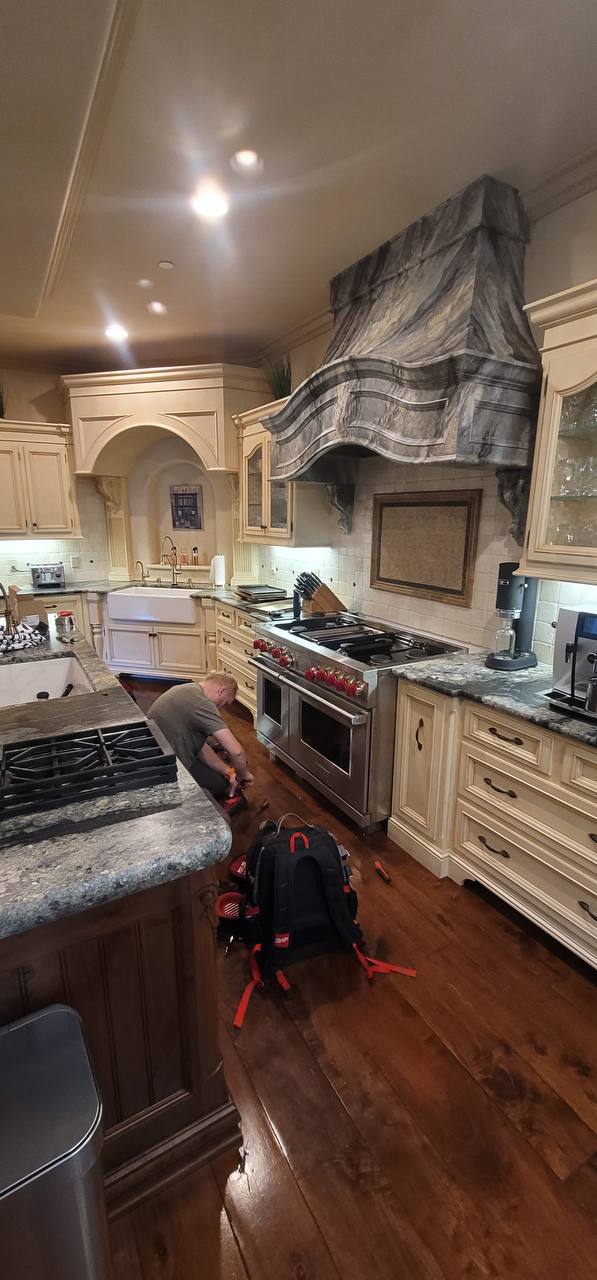
Your oven holds its preheat at room temperature, or it climbs to 200 and stalls. The broiler might still work. The stovetop might be fine. So why is the oven not heating up?
Most no-heat ovens come down to one of three parts: the igniter (gas), the bake element (electric), or the control board (either type). Here is how to tell which one you are dealing with, and where the line sits between a safe check and a service call.
First, narrow it down
Before touching anything, answer two questions.
Is the oven gas or electric? Look for a gas line behind the range or a 240V outlet. Gas ovens light a burner; electric ovens glow a metal element.
Does the broiler work but not bake (or the reverse)? That split is a strong clue. Bake and broil use different elements or different igniters, and a working one proves the oven has power and a live control board. The dead one points you straight at that specific component.
Gas oven: the igniter is the usual culprit
On a gas oven, the most common no-heat cause is a weak igniter. The igniter does two jobs: it glows hot, and it draws enough current to trip the safety gas valve open. As it ages it still glows but pulls less current, so the valve never opens. You see a dull orange glow and the burner never lights.
If you smell gas in the kitchen, skip this check. Leave the house and call 911 and PG&E at 1-800-743-5000 from a safe distance. What you can check safely: with the oven set to bake, look through the slot at the bottom of the cavity. A good igniter glows bright white-orange and lights the burner within 60 to 90 seconds. A dull, lazy orange that never lights means the igniter is done. Do not keep cycling it, raw gas builds up first.
This is a replacement part, not a cleaning job. Igniters are brittle and easy to crack, and the wiring connector sits in a tight spot near the gas supply. This is where we usually take over.
Electric oven: look at the bake element
On an electric oven, the floor of the cavity holds the bake element, a thick metal loop. When it fails it either stops glowing entirely or develops a break.
What you can check safely, with the oven OFF and cool: open the door and inspect the element end to end. A burned-out element often shows a blister, a split, or a bright scorch mark at the failure point. No visible damage but the oven still won’t heat? That shifts suspicion to the wiring behind it or the control board, and both of those are pro territory.
When it is the control board
If the igniter glows fine, or the element looks perfect, and the oven still will not heat, the control board (also called the EOC, electronic oven control) is the next suspect. The board runs the relays that send voltage to the element or open the gas valve. A failed relay, a cracked solder joint, or a blown internal fuse leaves you with a cold oven and sometimes an error code on the display.
Control boards are not a DIY guess-and-swap part. They are expensive, they fail in ways that mimic element faults, and ordering the wrong one wastes a week. We test the board against the element and igniter circuits before we condemn it, so you are not paying for an expensive part the oven did not need. See our Wolf range control board job notes and our cooking appliance repair service for how we approach these.
A Gas Oven Burner and Igniter, On Camera
Where to stop and call
Visual inspection and the broil-vs-bake test are fine to do yourself. Beyond that:
-
Anything involving the gas supply, the gas valve, or replacing an igniter
-
Replacing an electric element that is fused to its terminals or shows scorched wiring
-
A suspected control board, which needs metering before you spend money on parts
Those are pro jobs. ADRIUM has been servicing Bay Area kitchens since 2021 (CSLB #1136642, BEAR #50788, BBB A+). We diagnose the actual fault, price the OEM part, and send a written estimate before the wrench comes out. The $99 diagnostic is credited to the repair.
Cold oven and a dinner to cook? Call (925) 999-4095 or email welcome@adriumservice.com. We cover the Bay Area.
FAQ
Why is my oven not heating up but the stovetop works? The cooktop and oven run on separate components. A working stovetop confirms power, so the fault is in the oven’s own igniter, element, or control board.
Igniter or element? Gas ovens: a dull glow that never lights the burner means a weak igniter. Electric ovens: a blistered or broken bake element on the cavity floor.
Can I keep using it? No. A weak gas igniter can let raw gas pool before it lights, and a damaged element can arc. Shut it off and book service.