
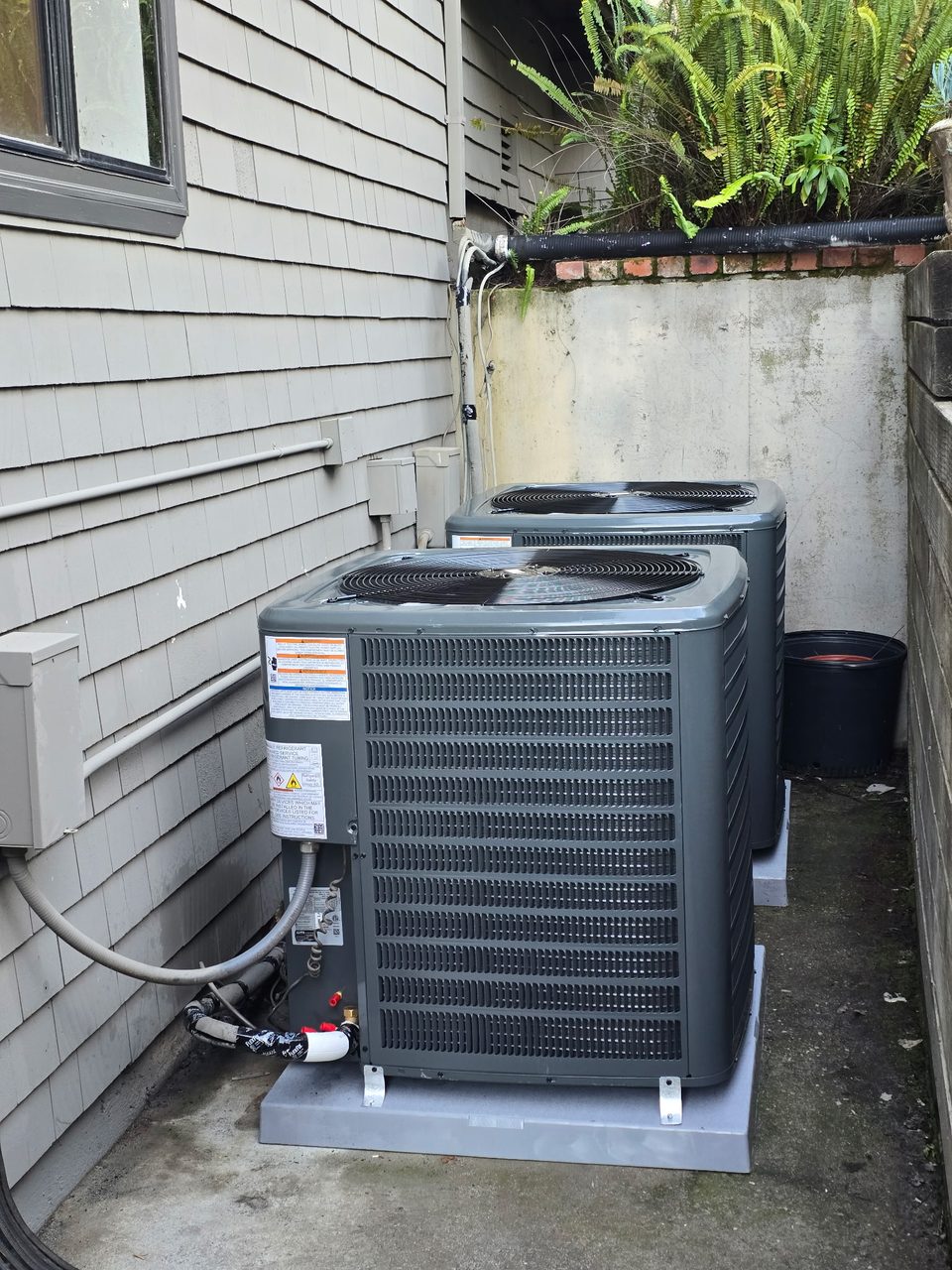
Wrong-sized equipment is the problem I find most often
When I pull the cover off a system that a customer says “never quite keeps up” or “cools the downstairs but not the bedrooms,” the size of the unit is wrong more often than the unit is broken. The mistake almost always runs in one direction. People assume a too-small AC is the usual trouble. In the Bay Area it’s the opposite. Most homes I look at are running equipment that’s too big.
The reason is simple. A 30 year old four ton system gets replaced with another four ton system because “we have a four ton now.” Nobody measures. The home that ran four tons in 1996 may have new dual-pane windows, a re-insulated attic, and tighter air sealing today. It needs two and a half or three tons. The customer pays for steel they don’t need, pays again every month on the utility bill, and pays a third time when the compressor wears out early.
Spot an oversized system without any tools
You don’t need a manifold gauge to catch this. Watch the run pattern on a hot afternoon.
An oversized AC turns on, throws cold air for three or four minutes, hits the thermostat setpoint, and shuts off. Ten minutes later it does it again. That’s short-cycling. Every one of those starts is the hardest moment in the compressor’s life, so doubling the number of starts roughly halves how long the equipment lasts.
You feel it too. An air conditioner pulls humidity out only while it runs, and short cycles never run long enough to dehumidify, so rooms end up cool but clammy. People turn the thermostat down to compensate, which makes the cycling worse.
Those same short bursts leave hot and cold spots. Cold air dumps onto the floor near the registers while the far bedrooms and the second story stay warm, because the ductwork can’t move that much instantaneous capacity where it needs to go.
Undersizing has the opposite signature. The system runs flat out on the hottest day and never quite catches the setpoint. In the Tri-Valley that happens maybe five to ten days a year. A slightly small system is far easier to live with than a badly oversized one.
The design temperature does most of the work
The Bay Area has the widest internal climate spread of any US metro. Sizing depends on which California Energy Commission climate zone the home sits in.
CZ3 covers the East Bay coast and the Peninsula. Oakland, Berkeley, Alameda, Richmond. Summer design temperature is around 81F right on the coast and warms to the mid-80s at the inland edge, where cities like Union City and Fremont sit. Many of these homes barely need AC at all.
CZ4 covers the South Bay. San Jose, Milpitas, Santa Clara, Sunnyvale. Design cooling runs near 92F. Summer cooling matters here.
CZ12 covers the Bay Area and Diablo Valley. San Ramon, Danville, Dublin, Pleasanton, Livermore, Walnut Creek, Concord. Design cooling sits near 99F. Both heating and cooling matter, and cooling drives equipment selection.
That’s why two identical floor plans on opposite sides of the Caldecott Tunnel need completely different equipment. Eighteen degrees of design temperature is the difference between two tons and four.
What actually moves the number
Floor area is the input everyone reaches for first, and it matters least of the real ones. In rough order of impact for a typical Bay Area home: climate zone, then window area and orientation, then insulation level, then air leakage, then duct location, then internal heat gain, and only then square footage. A wall of west-facing glass in San Ramon adds close to a ton of afternoon load that the same glass facing east does not. A 1965 home with original R-11 walls loses heat far faster than the same home re-insulated to code.
Manual J, the load calculation standard required on every California install permit, takes all of those inputs and solves the heat-flow equations. It produces a cooling load and a heating load in BTU per hour. Divide the cooling number by 12,000 and you get tons. What Manual J will never accept as an input is “we have a three ton now.”
Realistic tonnage ranges by area
These are starting points. The envelope and ductwork still move the final number, so treat them as a sanity check, not a spec.
Tri-Valley and Diablo Valley, CZ12: a 1,200 to 1,800 square foot single story usually lands at 2 to 3 tons. From 1,800 to 2,500 square feet, 3 to 4 tons. A 2,500 to 3,500 square foot two-story is often 3.5 to 5 tons and frequently wants two zones.
South Bay, CZ4: 1,200 to 1,800 square feet runs 2 to 2.5 tons. From 1,800 to 2,500 square feet, 2.5 to 3.5 tons.
East Bay coast, CZ3: many of these homes do better with a ductless mini-split per room than a central system. A 1,200 to 1,800 square foot home needs only 1.5 to 2 tons, or two to three mini-split heads.
If a quote you’re holding is a full ton above the top of these ranges, ask the contractor to show you the Manual J. There should be one on file for the permit.
A note on rebates and the expired tax credit
Budget around real numbers. The federal 25C heat-pump tax credit expired on December 31 2025 under the OBBBA, so it’s gone. Tech Clean California is closed to new enrollment. Utility programs change, so at the estimate I confirm what is actually paying at that moment rather than quoting a figure that may have lapsed.
Heat pumps follow the same rules with one extra step
A heat pump has to meet both the cooling load and the heating load. In CZ12, where design heating is near 30F and design cooling near 99F, the cooling load almost always governs. The unit sized for a San Ramon July is more than enough for the coldest February morning. Modern cold-climate equipment from Daikin and Mitsubishi holds rated capacity well below freezing, so the old objection that heat pumps quit when it gets cold refers to 1990s hardware and doesn’t apply to a 2026 install.
Where the deep HVAC work happens
I am EPA 608 certified, licensed under CSLB #1136642, Daikin factory-trained, and I have completed Mitsubishi factory courses. The $99 diagnostic is credited toward the repair, every quote is in writing, and installs carry a 10-year parts warranty plus a labor warranty (2 years standard, extended to 10 years with our maintenance plan), subject to your contract terms.
HVAC system design and load calculation is the specialty of our dedicated division, Bay Area HVAC Service, where the deep sizing work lives. If you want a measured Manual J or a replacement plan for your home, start there at bayareahvacservice.com, or call (925) 999-4095 and we will come measure for real.