
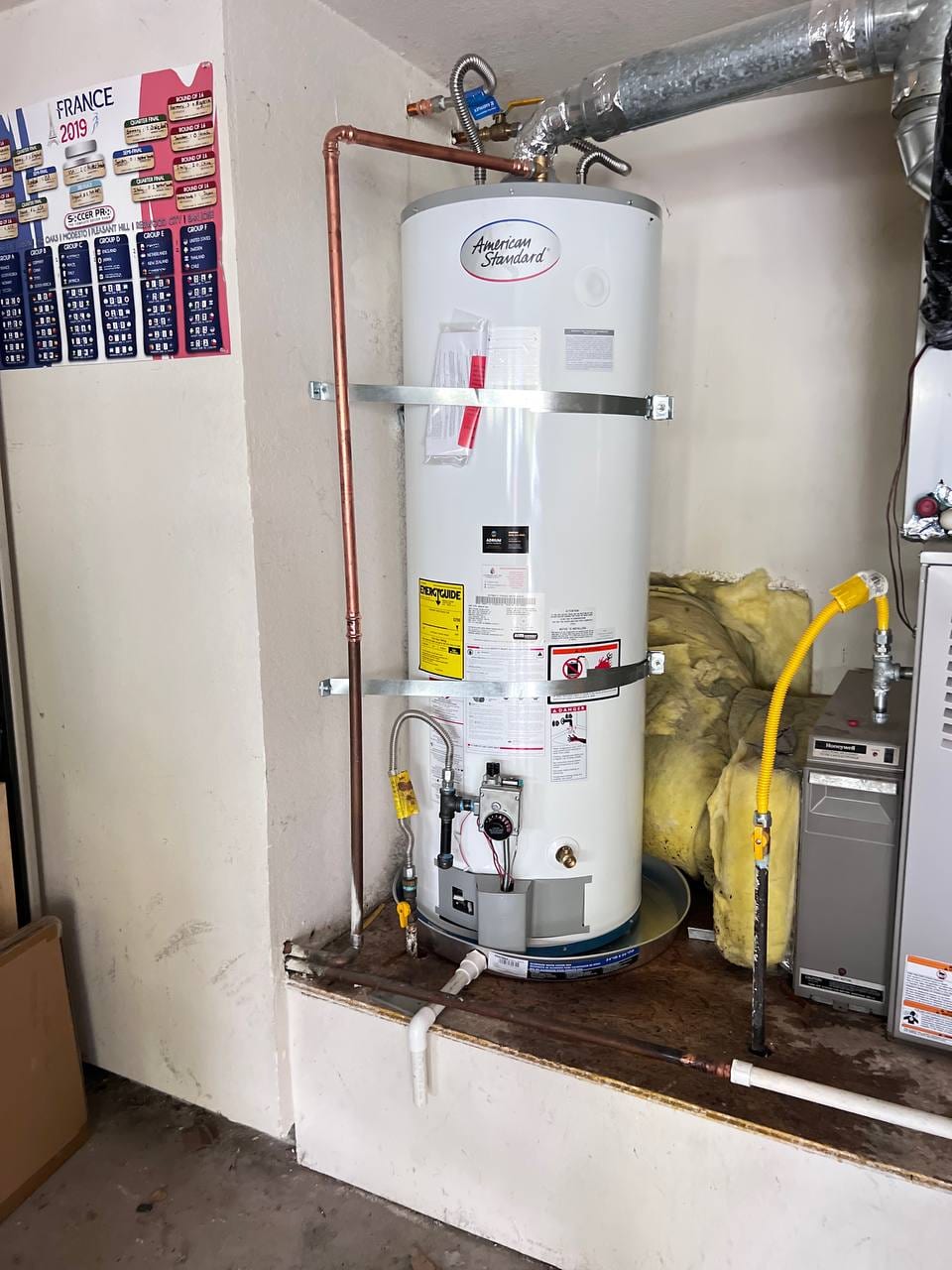
A gas water heater that quits, leaks, or starts rumbling lands the same question on me almost every week. Repair or replace. The contractor’s reflex is replace, because that is the bigger invoice. The internet’s reflex is repair, because that is the cheaper Saturday. Neither reflex is a diagnosis. Three things settle it: how old the tank is, what actually broke, and how the repair cost lines up against a new unit. I walk customers through all three before I quote anything.
Age sets the ceiling on every repair decision
A standard atmospheric tank gas water heater gives you 10 to 12 years in our water. Once a tank crosses those marks, the components are aging together, so fixing one part just moves you to the front of the line for the next one. That changes the math even on a cheap repair.
Reading the age takes thirty seconds. Find the manufacturer label on the side of the tank and look at the serial number, which is date coded. For Rheem, AO Smith, and many others, the first four digits are year plus week, so a serial opening with 2419 is the 19th week of 2024, a young tank worth repairing. Bradford White uses a letter code for the year rather than digits, so the decode is different for those. One that opens with 1307 is 2013, past its expected life, and I am not going to talk you into a $400 part for it. If you cannot find or decode the label, send us a photo of the label and we will tell you.
What broke decides whether repair is even possible
The failure mode rules out half the options before cost ever enters the conversation.
Water pooling under the tank means the steel shell has rusted through from the inside. There is no repair for a leaking tank, and the longer it sits the more likely you are paying for drywall and flooring too. That is a replace, and usually a soon one.
Water at the top is a different animal. It is almost always the inlet or outlet nipple, or the T&P relief valve, and those are repairable fittings.
A pilot that keeps dropping out, or no ignition at all, points to a thermocouple, a gas control valve, the pilot tube, or a venting problem. Worth checking the vent here, because the same symptom shows up when the flue is partly blocked, and a blocked flue spills combustion gas back into the room. If a CO detector has gone off, get everyone out of the house and call 911 from outside. Don’t go back in until the responders say it’s safe.
Not enough hot water is usually sediment choking the burner, sometimes a thermostat, sometimes a tank that is simply too small for how the household uses water now. Rumbling and popping is the same sediment story, water flashing to steam in pockets under the crud at the bottom. A flush fixes both more often than people expect. Rusty water is either a spent anode rod, which is cheap, or a corroding tank liner, which is not fixable.
The repair has to cost less than half a replacement
Once the failure mode allows a repair, I use a simple rule. If the repair runs past 50 percent of a full replacement, replace instead. A $400 gas valve on a 12-year-old tank fails that test, because $1,800 buys you another decade and a fresh warranty. The same $400 valve on a 4-year-old tank passes easily.
I treat 50 percent as a starting line, not a verdict. Warranty status moves it, since parts still under factory coverage cost you only labor. So does sizing. Bumping a family from 50 to 75 gallons is sometimes a good reason to retire a tank that still technically works.
A real replacement carries code work that cheap bids quietly drop
The gap between a $1,500 water heater install and a $3,000 one is rarely the tank. It is the code work and the permit, and that is where corners get cut.
A proper swap includes a quarter-turn ball valve for the gas shutoff instead of the old globe style, a T&P relief valve with discharge piping run to a safe termination, and seismic strapping at the upper and lower thirds of the tank, which California requires. The licensed plumber we work with confirms the vent draft suits the new unit, leak-tests every gas and water joint before commissioning, and pulls the permit. The permit fee is small. Its real value is the paper trail when you sell, because a buyer’s inspector will flag an unpermitted swap. The cheaper bid that skips all of this is genuinely cheaper. We see the bill for it a year later when something else brings us back and the original install has to be corrected first.
Our diagnostic is $99 and we credit it toward the repair, and you get a written quote with one total price before anything happens. If you already have a repair quote and want a second read, I am glad to look and tell you straight, even when the call I give you is that the quote you are already holding is the right one. Whole-home efficiency questions tie into this too, and our home energy assessment covers water heating alongside heating and cooling. For larger HVAC work our HVAC division, Bay Area HVAC Service, handles the heavy installs.