
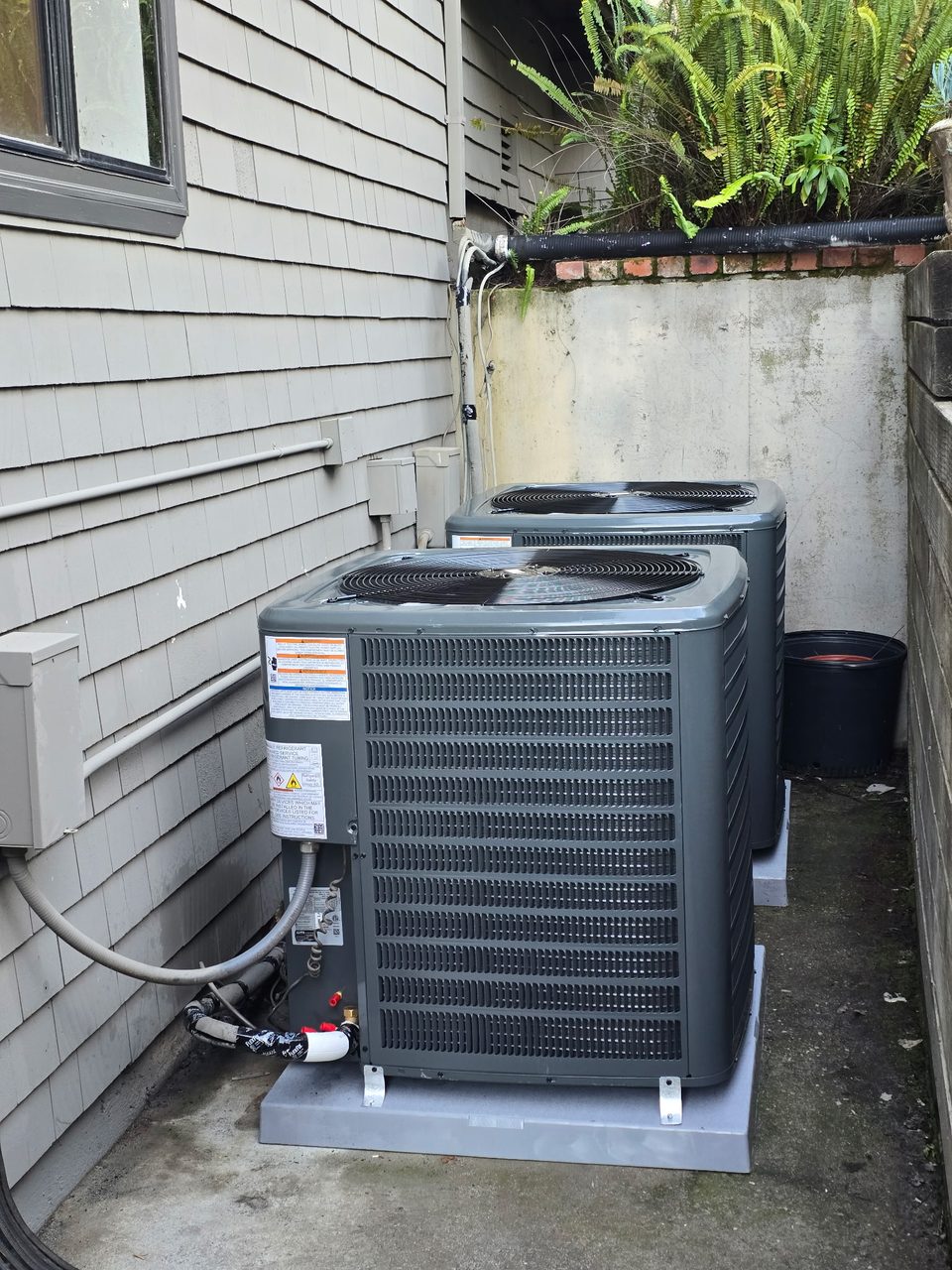
When a homeowner asks me what size air conditioner or heat pump they need, my first answer is that size is the wrong word. A ton of cooling is 12,000 BTU/h of heat the system can move per hour. It has nothing to do with how big the box is or how many square feet sit under the roof. Picking tonnage is a heat balance problem. You add up everything that puts heat into the house on a hot afternoon, and you buy equipment that can remove exactly that much. Not more.
The “not more” part surprises people. Most of the comfort calls I get on systems installed elsewhere come down to equipment that is too big, not too small. So this guide is built around that one fact, because oversizing is the expensive mistake almost nobody warns you about.
A ton is heat capacity, and the load comes from the envelope
The number you actually care about is the cooling load, the BTU/h of heat your house gains on a design day. Five things drive it, roughly in order: window area and orientation, insulation level, air leakage, duct location and condition, and floor area. Notice square footage is last. Two identical 2,000 square foot homes can differ by a full ton if one faces west with single pane glass and the other has dual pane low e windows and a sealed attic.
This is why the old “500 square feet per ton” rule fails here. That rule was fit to 1970s ranch houses with R-11 walls and single pane windows baking in Phoenix or Dallas. It assumes a leaky envelope and a 105 to 115F design temperature. A Bay Area home built after 1978 with normal insulation lands closer to 600 to 900 square feet per ton, and a tight post 2010 home near the coast can run 1,000. Apply the 500 rule to a coastal home and you oversize it by 40 to 50 percent.
The design temperature is lower than people expect
Manual J does not size to the record high. It sizes to the 1 percent design temperature, the outdoor temperature your area exceeds only about 1 percent of the hours in a year. For inland Bay Area zones that is roughly 99 to 100F. For South Bay it is lower, and near the coast lower still. The handful of 105F afternoons a year are handled by running near full capacity for a few hours, plus shading and good airflow. They are not a reason to buy a bigger compressor that then runs badly the other 360 days.
This is the root of the “round up to be safe” mistake. The safety margin protects against a few hours and degrades performance for the entire season.
Oversizing is a real failure mode, not a harmless cushion
Here is what too much capacity actually does in a house.
A single stage AC that is oversized cools the air fast, satisfies the thermostat, and shuts off before it has run long enough to pull moisture out of the air or even out the temperature room to room. That is short cycling. You get cold blasts, then drift, then another blast. Comfort suffers, humidity stays high, and the compressor sees more start stop wear, which is the hardest thing on its life.
Variable speed inverter equipment is worse to oversize, not better. These systems are designed to spend 70 to 80 percent of their hours at partial load, modulating quietly. But they have a floor. Minimum output is roughly 30 percent of rated capacity. A right sized 3 ton heat pump can throttle down to about 0.9 tons. Put in a 3.5 ton unit “for safety” and the floor rises to about 1.05 tons. On a mild evening that needs 0.7 tons, the bigger unit cannot get low enough, so it short cycles and you lose the smooth modulation you paid extra for. The SEER2 rating on the box assumes the equipment modulates through its range. Oversize it and that efficiency disappears.
A hot upstairs is an airflow problem, not a capacity problem
Two story homes often run hot upstairs, and the instinct is more cooling. It is the wrong fix every time I have audited it. Hot upstairs means conditioned air is not reaching the second floor. Bigger equipment just pushes more cold air through the same ducts, and most of it still settles downstairs. The real fixes are a second floor return, duct sealing in the attic, zoning with motorized dampers, or a dedicated ductless head for the problem room. Sizing math should never be asked to solve a distribution problem.
What we measure before quoting a number
On an installation estimate we walk the envelope: window count and orientation, insulation in the attic and walls, vintage and air leakage, duct runs and their condition, and the existing equipment if it is a replacement. That feeds a Manual J calculation, which outputs heating and cooling loads in BTU/h and tons, plus a check on whether your existing ducts can move the new airflow without excess static pressure. Then we match equipment to the result and put it in a written quote. The $99 diagnostic is credited toward the repair.
Old equipment tonnage is one data point, not the answer. The only thing the old nameplate tells me is whether the previous system was so undersized it never kept up. Otherwise the new number comes from the house as it stands today.
A short note on money, since people ask. I will give install cost ranges on the phone, and we confirm what any rebate program is actually paying at estimate time rather than quoting a figure that may have changed. The federal 25C heat pump tax credit ended on December 31, 2025, so do not build it into your budget. We are EPA 608 certified, hold CSLB license #1136642, and back installs with a 10-year parts warranty; labor is 2 years standard, extended to 10 years with our maintenance plan.
Deep HVAC design and load work is the specialty of our dedicated division, Bay Area HVAC Service. Either way, get a real Manual J before any contractor sells you on tonnage.